
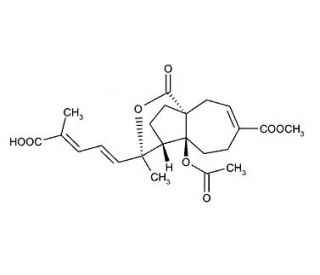

Pseudolaric acid B (CAS 82508-31-4)
QUICK LINKS
Pseudolaric acid B is a naturally occurring diterpene acid extracted from the bark of Pseudolarix amabilis, a tree native to East Asia. This compound has captivated the interest of researchers due to its unique mechanism of action as a mitotic inhibitor. Specifically, Pseudolaric acid B disrupts the normal function of microtubules, cellular structures essential for mitosis. It binds to tubulin, the protein building block of microtubules, thereby inhibiting their polymerization and leading to cell cycle arrest at the G2/M phase. This action results in the prevention of cellular division, which is a critical process for cell proliferation. In research environments, Pseudolaric acid B serves as a valuable tool for studying cell cycle regulation and the dynamics of microtubule assembly. Its ability to halt the proliferation of cells at a specific phase allows scientists to dissect the roles of various cellular components involved in cell division and to understand the underlying regulatory mechanisms. Additionally, studies involving this compound help in exploring the pathways through which cells respond to mitotic disruption, including the activation of apoptosis pathways and the cellular responses to stress, thereby contributing to a broader understanding of cellular behavior under disruptive conditions.
Pseudolaric acid B (CAS 82508-31-4) References
- Pseudolaric acid B induces apoptosis via activation of c-Jun N-terminal kinase and caspase-3 in HeLa cells. | Gong, X., et al. 2004. Exp Mol Med. 36: 551-6. PMID: 15665588
- Pseudolaric acid B circumvents multidrug resistance phenotype in human gastric cancer SGC7901/ADR cells by downregulating Cox-2 and P-gp expression. | Yu, F., et al. 2015. Cell Biochem Biophys. 71: 119-26. PMID: 25077681
- Pseudolaric acid B inhibits neuroglioma cell proliferation through DNA damage response. | Song, F., et al. 2017. Oncol Rep. 38: 2211-2218. PMID: 28765951
- Pseudolaric acid B induced autophagy, but not apoptosis, in MRC5 human fibroblast cells. | Wang, Y., et al. 2018. Oncol Lett. 15: 863-870. PMID: 29399151
- Pseudolaric acid B triggers ferroptosis in glioma cells via activation of Nox4 and inhibition of xCT. | Wang, Z., et al. 2018. Cancer Lett. 428: 21-33. PMID: 29702192
- Pseudolaric acid B exhibits anti-cancer activity on human hepatocellular carcinoma through inhibition of multiple carcinogenic signaling pathways. | Zhang, H., et al. 2019. Phytomedicine. 59: 152759. PMID: 31004883
- Pseudolaric acid B induces mitotic arrest and apoptosis in both imatinib-sensitive and -resistant chronic myeloid leukaemia cells. | Jiang, L., et al. 2020. Eur J Pharmacol. 876: 173064. PMID: 32179085
- Pseudolaric acid B induces apoptosis in human rhabdomyosarcoma RD cells. | Liu, C., et al. 2020. Oncol Lett. 20: 358. PMID: 33133258
- Pseudolaric Acid B Inhibits Proliferation, Invasion, and Angiogenesis in Esophageal Squamous Cell Carcinoma Through Regulating CD147. | Yin, Z., et al. 2020. Drug Des Devel Ther. 14: 4561-4573. PMID: 33149553
- Pseudolaric acid B ameliorates synovial inflammation and vessel formation by stabilizing PPARγ to inhibit NF-κB signalling pathway. | Lu, J., et al. 2021. J Cell Mol Med. 25: 6664-6678. PMID: 34117708
- Antitumor Effect of Pseudolaric Acid B Involving Regulation of Notch1/Akt Signaling Response in Human Hepatoma Cell In Vitro. | Gao, H., et al. 2022. Evid Based Complement Alternat Med. 2022: 5353686. PMID: 35747382
- Suppressive effect of pseudolaric acid B on Echinococcus multilocularis involving regulation of TGF-β1 signaling in vitro and in vivo. | Gao, H., et al. 2022. Front Microbiol. 13: 1008274. PMID: 36439797
Ordering Information
| Product Name | Catalog # | UNIT | Price | Qty | FAVORITES | |
Pseudolaric acid B, 100 µg | sc-203221 | 100 µg | $29.00 | |||
Pseudolaric acid B, 1 mg | sc-203221A | 1 mg | $74.00 |