
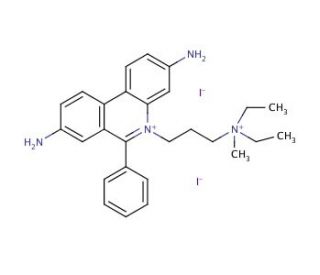

Propidium Iodide (CAS 25535-16-4)
See product citations (168)
QUICK LINKS
Propidium Iodide (PI) is a fluorescent dye that binds to nucleic acids and is widely used in cell biology to assess cell viability or to analyze cell cycle stages by flow cytometry and fluorescence microscopy. Structurally similar to the nucleic acid base guanine, PI is impermeable to live cells but can penetrate cell membranes of dead or dying cells where it intercalates between the bases of DNA and, to a lesser extent, RNA. Upon binding to nucleic acids, the fluorescence of PI is significantly enhanced, emitting a bright red fluorescence under illumination, making it an excellent tool for identifying and quantifying necrotic and apoptotic cells. The mechanism of action involves the intercalation of PI into double-stranded areas of nucleic acids; this property is exploited in research to assess membrane integrity as a marker of cell death. Additionally, PI is used in conjunction with other DNA-binding dyes in flow cytometry to evaluate the DNA content of cells, thereby facilitating the analysis of cell cycle phases such as G1, S, and G2/M phases. The distinct fluorescence emission of PI at around 617 nm allows for its use in multi-color labeling experiments, where it can be combined with other fluorophores for simultaneous detection of multiple cellular targets, enhancing the depth of cellular analysis in research settings.
Propidium Iodide (CAS 25535-16-4) References
- Analysis of apoptotic cells by flow and laser scanning cytometry. | Darzynkiewicz, Z. and Bedner, E. 2000. Methods Enzymol. 322: 18-39. PMID: 10914002
- Features of apoptotic cells measured by flow cytometry. | Darzynkiewicz, Z., et al. 1992. Cytometry. 13: 795-808. PMID: 1333943
- Propidium iodide staining underestimates viability of adherent bacterial cells. | Rosenberg, M., et al. 2019. Sci Rep. 9: 6483. PMID: 31019274
- Optimization of staining with SYTO 9/propidium iodide: interplay, kinetics and impact on Brevibacillus brevis. | Deng, Y., et al. 2020. Biotechniques. 69: 88-98. PMID: 32393121
- Propidium iodide enabled live imaging of Pasteuria sp.-Pratylenchus zeae infection studies under fluorescence microscopy. | Perrine-Walker, F. and Le, K. 2021. Protoplasma. 258: 279-287. PMID: 33070241
- An Annexin V-FITC-Propidium Iodide-Based Method for Detecting Apoptosis in a Non-Small Cell Lung Cancer Cell Line. | Kumar, R., et al. 2021. Methods Mol Biol. 2279: 213-223. PMID: 33683697
- Rapid Determination of Antibiotic Resistance in Klebsiella pneumoniae by a Novel Antibiotic Susceptibility Testing Method Using SYBR Green I and Propidium Iodide Double Staining. | Zhang, Y., et al. 2021. Front Microbiol. 12: 650458. PMID: 34177832
- Detection of gamma radiation processed onion during storage using propidium iodide based fluorescence microscopy. | Sharma, T., et al. 2023. Food Chem. 398: 133928. PMID: 35988414
- Fundamental aspects of the interaction of propidium diiodide with nuclei acids studied in a model system of polyacrylamide films. | Tas, J. and Westerneng, G. 1981. J Histochem Cytochem. 29: 929-36. PMID: 6168679
- Measurement of apoptosis. | Darzynkiewicz, Z. and Traganos, F. 1998. Adv Biochem Eng Biotechnol. 62: 33-73. PMID: 9755640
Ordering Information
| Product Name | Catalog # | UNIT | Price | Qty | FAVORITES | |
Propidium Iodide, 50 mg | sc-3541 | 50 mg | $101.00 | |||
Propidium Iodide, 250 mg | sc-3541A | 250 mg | $296.00 |