
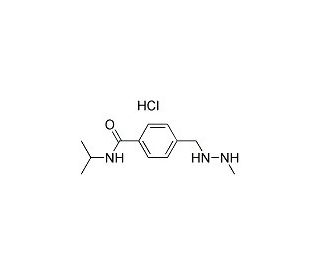

Procarbazine Hydrochloride (CAS 366-70-1)
QUICK LINKS
Procarbazine hydrochloride is a chemical compound that functions as an alkylating agent in and development settings. It acts by inhibiting DNA and RNA synthesis through alkylation of the DNA molecule, leading to the disruption of DNA replication and transcription processes. Procarbazine hydrochloride targets and cross-links DNA strands, interfering with the normal functioning of the genetic material. By inducing DNA damage, procarbazine hydrochloride disrupts the cell cycle and triggers apoptosis in rapidly dividing cells. Its mode of action involves the formation of DNA adducts, which ultimately leads to cell death. Procarbazine hydrochloride′s function in experimental involves its ability to induce DNA damage and interfere with cellular processes, making it a useful for studying the mechanisms of DNA damage and repair.
Procarbazine Hydrochloride (CAS 366-70-1) References
- The effect of enzyme-inducing antiseizure drugs on the pharmacokinetics and tolerability of procarbazine hydrochloride. | Grossman, SA., et al. 2006. Clin Cancer Res. 12: 5174-81. PMID: 16951236
- Flow cytometric analysis of Pig-a gene mutation and chromosomal damage induced by procarbazine hydrochloride in CD-1 mice. | Phonethepswath, S., et al. 2013. Environ Mol Mutagen. 54: 294-8. PMID: 23427001
- Integrated In Vivo Genotoxicity Assessment of Procarbazine Hydrochloride Demonstrates Induction of Pig-a and LacZ Mutations, and Micronuclei, in MutaMouse Hematopoietic Cells. | Maurice, C., et al. 2019. Environ Mol Mutagen. 60: 505-512. PMID: 30592561
- Regenerative medicine for male infertility: A focus on stem cell niche injury models. | Sagaradze, G., et al. 2022. Biomed J. 45: 607-614. PMID: 35123107
- N-methyl antitumour agents. A distinct class of anticancer drugs? | Newell, D., et al. 1987. Cancer Chemother Pharmacol. 19: 91-102. PMID: 3552281
- Impact on the survival of neutrophil-lymphocyte ratio, platelet-lymphocyte ratio, and monocyte-lymphocyte ratio on prognosis in children with Hodgkin lymphoma. | Ertan, K., et al. 2022. Saudi Med J. 43: 451-457. PMID: 35537727
- The outcome of older adults with classic Hodgkin lymphoma in British Columbia. | Cheng, PTM., et al. 2022. Blood Adv. 6: 5924-5932. PMID: 36075016
- The Outcome of Hodgkin Lymphoma With Reference to Prognostic Markers. | Ahmed, R., et al. 2022. Cureus. 14: e28421. PMID: 36176827
- Recurrence of Angioimmunoblastic T-cell Lymphoma in a Patient Successfully Treated for Hodgkin's Lymphoma: A Case Report. | Nasir, SA., et al. 2022. Cureus. 14: e29867. PMID: 36348839
- Objective response rate targets for recurrent glioblastoma clinical trials based on the historic association between objective response rate and median overall survival. | Ellingson, BM., et al. 2023. Neuro Oncol. 25: 1017-1028. PMID: 36617262
- A Rare Case of Primary Anorectal Hodgkin Lymphoma in an HIV-Positive Patient: A Case Report and Literature Review. | Perez, FM., et al. 2023. Cureus. 15: e38796. PMID: 37303441
- Duplex sequencing provides detailed characterization of mutation frequencies and spectra in the bone marrow of MutaMouse males exposed to procarbazine hydrochloride. | Dodge, AE., et al. 2023. Arch Toxicol. 97: 2245-2259. PMID: 37341741
Ordering Information
| Product Name | Catalog # | UNIT | Price | Qty | FAVORITES | |
Procarbazine Hydrochloride, 100 mg | sc-204862 | 100 mg | $84.00 | |||
Procarbazine Hydrochloride, 500 mg | sc-204862A | 500 mg | $226.00 |