
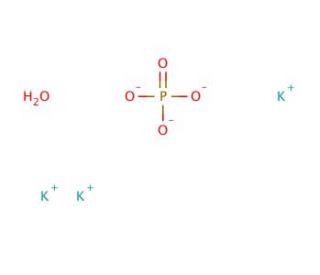

Potassium phosphate tribasic monohydrate (CAS 27176-10-9)
QUICK LINKS
Potassium phosphate tribasic monohydrate is a reagent with a very high buffering capacity. Widely used in molecular biology, biochemistry, and chromatography. Potassium phosphate occurs in several forms: monobasic (KH2PO4), dibasic (K2HPO4), and tribasic (K3PO4). Neutral potassium phosphate buffer solutions may be prepared with a mixture of the monobasic and dibasic forms to varying degrees, depending on the desired pH. Potassium Phosphate buffers are very useful in numerous applications, but with the following limitations; precipitation of Ca2+ and Mg2+, inhibition of restriction enzyme activity, and interference in DNA ligation or bacterial transformation protocols. Has been used to study the effects of freezing and thawing on the stability of proteins sensitive to conformational changes; it was found that KP buffers offered improved pH stability as opposed to NaP buffers. Potassium Phosphate has also been used for the extraction of keratohyalin protein from bovine tissue.
Additional forms available:
Potassium Phosphate, Dibasic, Anhydrous (sc-203210)
Potassium Phosphate, Monobasic (sc-203211)
Potassium phosphate tribasic (sc-250766)
Potassium phosphate dibasic solution (sc-301600)
Potassium Phosphate Monobasic solution (sc-301601)
Potassium phosphate tribasic monohydrate (CAS 27176-10-9) References
- Protein denaturation during freezing and thawing in phosphate buffer systems: monomeric and tetrameric beta-galactosidase. | Pikal-Cleland, KA., et al. 2000. Arch Biochem Biophys. 384: 398-406. PMID: 11368330
- Ionic Colloidal Molding as a Biomimetic Scaffolding Strategy for Uniform Bone Tissue Regeneration. | Zhang, J., et al. 2017. Adv Mater. 29: PMID: 28221007
- Efficient cross-coupling of aryl/alkenyl triflates with acyclic secondary alkylboronic acids. | Si, T., et al. 2017. Org Biomol Chem. 15: 9903-9909. PMID: 29159328
- Synthesis of Polysubstituted Isoquinolines and Related Fused Pyridines from Alkenyl Boronic Esters via a Copper-Catalyzed Azidation/Aza-Wittig Condensation Sequence. | Jayaram, V., et al. 2018. J Org Chem. 83: 843-853. PMID: 29251507
- Construction of versatile multilayered composite nanoparticles from a customized nanogel template. | Zhang, J., et al. 2018. Bioact Mater. 3: 87-96. PMID: 29744445
- Regio- and stereocontrolled synthesis of borylated E-enynes, Z-enediynes and derivatives from alkenyl-1,2-bis-(boronates). | Ratanlal, M., et al. 2023. Org Biomol Chem. 21: 7567-7571. PMID: 37671616
- Further characterization of bovine keratohyalin. | Ugel, AR. and Idler, W. 1972. J Cell Biol. 52: 453-64. PMID: 5057980
- Thermodynamic modeling of hydroxyapatite crystallization with biomimetic precursor design considerations. | Mossaad, C., Starr, M., Patil, S., & Riman, R. E. 2010. Chemistry of Materials. 22(1): 36-46.
- Palladium-Catalyzed Cross-Coupling/Annulation Cascade for Synthesis of 9-Hydroxy and 9-Aminofluorenes. | François, B., Szczubelek, L., Berrée, F., Roisnel, T., & Carboni, B. 2018. Advanced Synthesis & Catalysis. 360(2): 235-241.
- Recovery of Ammonium from Biomass-Drying Condensate Via Ion Exchange and Its Valorization as a Fertilizer | Song, J., Heinonen, J., & Sainio, T. 2023. Processes. 11(3): 815.
Ordering Information
| Product Name | Catalog # | UNIT | Price | Qty | FAVORITES | |
Potassium phosphate tribasic monohydrate, 500 g | sc-250767 | 500 g | $61.00 | |||
Potassium phosphate tribasic monohydrate, 1 kg | sc-250767A | 1 kg | $107.00 |