
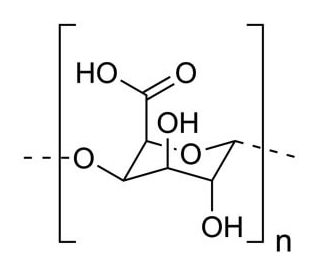

Polygalacturonic acid (CAS 25990-10-7)
QUICK LINKS
Polygalacturonic acid, a polymer derived from galacturonic acid units linked by α-(1,4) glycosidic bonds, is extensively used in the field of plant biology and material science research. This polysaccharide is a major component of pectin, a structural heteropolysaccharide found in the cell walls of plants. Due to its gel-forming capabilities when combined with sugar and acid, it has significant applications in studying cell wall structure and dynamics. In scientific research, polygalacturonic acid is utilized to investigate the properties and behavior of plant cell walls, particularly how they modulate plant growth and respond to environmental stresses. Its ability to bind with divalent cations like calcium leads to cross-linking in the cell wall, affecting its porosity and mechanical strength, which are crucial for understanding plant physiology and development. Additionally, this compound is applied in material sciences, where its biodegradability and gel-forming properties are exploited in the creation of biocompatible films and hydrogels. These materials are of interest for encapsulating enzymes or as carriers in the controlled release of agricultural nutrients and pesticides, emphasizing its utility in green technology and sustainable agricultural practices. Through these applications, polygalacturonic acid aids in advancing our understanding of both plant biology and eco-friendly material development, contributing valuable insights into natural polymer functionality.
Polygalacturonic acid (CAS 25990-10-7) References
- Cellulose-nanofiber/polygalacturonic acid coatings with high oxygen barrier and targeted release properties. | Mølgaard, SL., et al. 2014. Carbohydr Polym. 114: 179-182. PMID: 25263879
- Ibuprofen-conjugated hyaluronate/polygalacturonic acid hydrogel for the prevention of epidural fibrosis. | Lin, CY., et al. 2016. J Biomater Appl. 30: 1589-600. PMID: 26935813
- Caprylic and Polygalacturonic Acid Combinations for Eradication of Microbial Organisms Embedded in Biofilm. | Rosenblatt, J., et al. 2017. Front Microbiol. 8: 1999. PMID: 29093703
- Non-aqueous solvent for efficient dissolution of polygalacturonic acid. | Würfel, H., et al. 2019. Carbohydr Polym. 207: 791-795. PMID: 30600067
- Wound healing of nanofiber comprising Polygalacturonic/Hyaluronic acid embedded silver nanoparticles: In-vitro and in-vivo studies. | El-Aassar, MR., et al. 2020. Carbohydr Polym. 238: 116175. PMID: 32299548
- Efficient heterogeneous synthesis of reactive polygalacturonic acid hydrazides. | Würfel, H., et al. 2021. Carbohydr Polym. 261: 117838. PMID: 33766338
- A method for quantitative characterization of incomplete degradation products of polygalacturonic acid. | Wang, T., et al. 2021. Int J Biol Macromol. 188: 343-349. PMID: 34389382
- Effects of oral administration and intravenous injection of polygalacturonic acid on the immunomodulation and gut microbiota in UC mice. | Song, J., et al. 2022. Int J Biol Macromol. 217: 150-160. PMID: 35830896
- Polygalacturonic acid trans-eliminase of Xanthomonas campestris. | Nasuno, S. and Starr, MP. 1967. Biochem J. 104: 178-85. PMID: 6035509
- POlygalacturonic acid transeliminase production by Azospirillum species. | Tien, TM., et al. 1981. Can J Microbiol. 27: 426-31. PMID: 7237287
Ordering Information
| Product Name | Catalog # | UNIT | Price | Qty | FAVORITES | |
Polygalacturonic acid, 5 g | sc-222183 | 5 g | $94.00 | |||
Polygalacturonic acid, 25 g | sc-222183A | 25 g | $109.00 |