
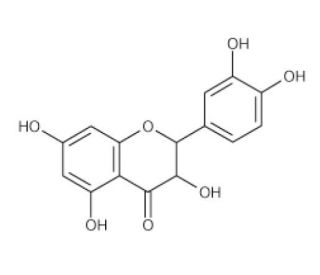

(±)-Taxifolin (CAS 480-18-2)
QUICK LINKS
(±)-Taxifolin is a flavonoid compound that functions as an antioxidant in experimental applications. It exerts its mechanism of action by scavenging free radicals and preventing oxidative damage to cellular components. (±)-Taxifolin is known to inhibit lipid peroxidation and protect against DNA damage caused by reactive oxygen species. (±)-Taxifolin may act to chelate metal ions, thereby reducing their ability to catalyze oxidative reactions. Its ability to modulate cellular redox status may be a useful for studying oxidative stress and its impact on biological systems. (±)-Taxifolin regulates various signaling pathways involved in inflammation and cell survival, contributing to its role in experimental research. (±)-Taxifolin plays a functional role in investigating the mechanisms of oxidative stress and cellular signaling pathways, making it useful for understanding the impact of these processes on biological systems.
(±)-Taxifolin (CAS 480-18-2) References
- Modulation of hepatic lipoprotein synthesis and secretion by taxifolin, a plant flavonoid. | Theriault, A., et al. 2000. J Lipid Res. 41: 1969-79. PMID: 11108730
- Inhibitory activity of diacylglycerol acyltransferase (DGAT) and microsomal triglyceride transfer protein (MTP) by the flavonoid, taxifolin, in HepG2 cells: potential role in the regulation of apolipoprotein B secretion. | Casaschi, A., et al. 2004. Atherosclerosis. 176: 247-53. PMID: 15380446
- An insight into the health-promoting effects of taxifolin (dihydroquercetin). | Sunil, C. and Xu, B. 2019. Phytochemistry. 166: 112066. PMID: 31325613
- 7-O-Esters of taxifolin with pronounced and overadditive effects in neuroprotection, anti-neuroinflammation, and amelioration of short-term memory impairment in vivo. | Gunesch, S., et al. 2020. Redox Biol. 29: 101378. PMID: 31926632
- Taxifolin ameliorate high-fat-diet feeding plus acute ethanol binge-induced steatohepatitis through inhibiting inflammatory caspase-1-dependent pyroptosis. | Zhan, ZY., et al. 2021. Food Funct. 12: 362-372. PMID: 33325949
- Taxifolin: A Potential Therapeutic Agent for Cerebral Amyloid Angiopathy. | Saito, S., et al. 2021. Front Pharmacol. 12: 643357. PMID: 33643053
- Pharmacological basis and new insights of taxifolin: A comprehensive review. | Das, A., et al. 2021. Biomed Pharmacother. 142: 112004. PMID: 34388527
- Exploring the Molecular Mechanism of Action of Yinchen Wuling Powder for the Treatment of Hyperlipidemia, Using Network Pharmacology, Molecular Docking, and Molecular Dynamics Simulation. | Ye, J., et al. 2021. Biomed Res Int. 2021: 9965906. PMID: 34746316
- Taxifolin Alleviates DSS-Induced Ulcerative Colitis by Acting on Gut Microbiome to Produce Butyric Acid. | Li, W., et al. 2022. Nutrients. 14: PMID: 35268045
- Interaction of flavonoids with ascorbate and determination of their univalent redox potentials: a pulse radiolysis study. | Bors, W., et al. 1995. Free Radic Biol Med. 19: 45-52. PMID: 7635358
- Suppression of hydroperoxide-induced cytotoxicity by polyphenols. | Nakayama, T. 1994. Cancer Res. 54: 1991s-1993s. PMID: 8137326
- Suppression of active oxygen-induced cytotoxicity by flavonoids. | Nakayama, T., et al. 1993. Biochem Pharmacol. 45: 265-7. PMID: 8381006
- Structure-antioxidant activity relationships of flavonoids and phenolic acids. | Rice-Evans, CA., et al. 1996. Free Radic Biol Med. 20: 933-56. PMID: 8743980
Ordering Information
| Product Name | Catalog # | UNIT | Price | Qty | FAVORITES | |
(±)-Taxifolin, 10 mg | sc-202828 | 10 mg | $52.00 | |||
(±)-Taxifolin, 50 mg | sc-202828A | 50 mg | $157.00 | |||
(±)-Taxifolin, 100 mg | sc-202828B | 100 mg | $292.00 | |||
(±)-Taxifolin, 500 mg | sc-202828C | 500 mg | $468.00 |