
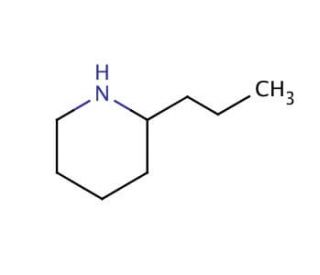

(±)-Coniine (CAS 3238-60-6)
QUICK LINKS
(±)-Coniine is a chemical compound that functions as a nicotinic acetylcholine receptor antagonist. It exerts its mode of action by competitively binding to the nicotinic acetylcholine receptor, thereby blocking the binding of acetylcholine. This interference inhibits the transmission of nerve impulses at the neuromuscular junction, leading to muscle paralysis. The compound′s mechanism of action involves disrupting the normal physiological function of the nicotinic acetylcholine receptor, ultimately resulting in the inhibition of muscle contraction. This functional role within experimental applications allows for the investigation of the receptor′s involvement in neuromuscular signaling and the study of muscle physiology. (±)-Coniine′s mode of action provides insights into the development of potential therapeutic agents targeting the nicotinic acetylcholine receptor.
(±)-Coniine (CAS 3238-60-6) References
- Poison hemlock (Conium maculatum L.). | Vetter, J. 2004. Food Chem Toxicol. 42: 1373-82. PMID: 15234067
- Retraction notice to 'The determination of nickel(II) after on-line sorbent preconcentration by inductively coupled plasma atomic emission spectrometry using Borassus Flabellifer inflorescence loaded with coniine dithiocarbamate'[J. Hazard. Mater. 112 (3) (2004) 233-238]. | . 2008. J Hazard Mater. 152: 450. PMID: 18572427
- Antinociceptive activity of coniine in mice. | Arihan, O., et al. 2009. J Ethnopharmacol. 125: 274-8. PMID: 19580858
- Nicotinic plant poisoning. | Schep, LJ., et al. 2009. Clin Toxicol (Phila). 47: 771-81. PMID: 19778187
- Toxicosis by Plant Alkaloids in Humans and Animals in Colombia. | Diaz, GJ. 2015. Toxins (Basel). 7: 5408-16. PMID: 26690479
- The effect of coniine on presynaptic nicotinic receptors. | Erkent, U., et al. 2016. Z Naturforsch C J Biosci. 71: 115-20. PMID: 27107833
- The killer of Socrates: Coniine and Related Alkaloids in the Plant Kingdom. | Hotti, H. and Rischer, H. 2017. Molecules. 22: PMID: 29135964
- [Rhabdomyolysis: have you considered food poisoning from quails?]. | Basile, C. 2020. G Ital Nefrol. 37: PMID: 32281758
- What kind of poison was used in 'The Name of the Rose'? | Konopka, T. 2020. Arch Med Sadowej Kryminol. 70: 191-201. PMID: 34431644
- De novo transcriptome assembly of Conium maculatum L. to identify candidate genes for coniine biosynthesis. | Peddinti, G., et al. 2022. Sci Rep. 12: 17562. PMID: 36266299
- Coniine, a teratogenic principle from Conium maculatum producing congenital malformations in calves. | Keeler, RF. 1974. Clin Toxicol. 7: 195-206. PMID: 4851158
- Evaluation of developmental toxicity of coniine to rats and rabbits. | Forsyth, CS. and Frank, AA. 1993. Teratology. 48: 59-64. PMID: 8351649
Ordering Information
| Product Name | Catalog # | UNIT | Price | Qty | FAVORITES | |
(±)-Coniine, 500 mg | sc-252626B | 500 mg | $204.00 | |||
(±)-Coniine, 1 g | sc-252626 | 1 g | $316.00 | |||
(±)-Coniine, 5 g | sc-252626A | 5 g | $867.00 |