
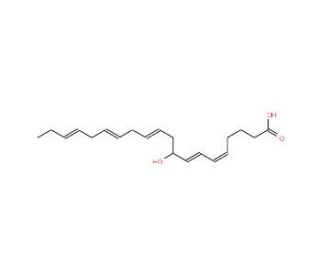

(±)9-HEPE
QUICK LINKS
(±)9-HEPE, a derivative of eicosapentaenoic acid (EPA), is an intriguing molecule in the realm of bioactive lipids. This compound incorporates a hydroxyl group at the ninth carbon of the EPA chain, a structural modification that significantly alters its biological interactions and functions. As a hydroxyeicosapentaenoic acid, (±)9-HEPE has been extensively studied in various research contexts to understand its role in modulating cellular mechanisms. It is particularly noted for its involvement in signaling pathways that regulate inflammatory processes and cellular responses to oxidative stress. The specific activity of (±)9-HEPE includes its ability to affect the production and activity of enzymes and signaling molecules that control the synthesis of inflammatory mediators. Research utilizing (±)9-HEPE has provided valuable insights into how such lipid molecules can influence key cellular activities, including signaling pathways related to inflammation and the response to environmental stressors. These studies contribute to a broader understanding of the physiological functions of omega-3 fatty acid derivatives, highlighting their potential role in modulating cellular environments and influencing the balance between pro-inflammatory and anti-inflammatory states in non-pathological research settings.
(±)9-HEPE References
- Hydroxyeicosapentaenoic acids from the Pacific krill show high ligand activities for PPARs. | Yamada, H., et al. 2014. J Lipid Res. 55: 895-904. PMID: 24668940
- Hydroxyeicosapentaenoic acids and epoxyeicosatetraenoic acids attenuate early occurrence of nonalcoholic fatty liver disease. | Wang, C., et al. 2017. Br J Pharmacol. 174: 2358-2372. PMID: 28471490
- Analysis of oxylipins to differentiate between organic and conventional UHT milks. | Samarra, I., et al. 2021. Food Chem. 343: 128477. PMID: 33160765
- Longer-Term Omega-3 LCPUFA More Effective Adjunct Therapy for Tuberculosis Than Ibuprofen in a C3HeB/FeJ Tuberculosis Mouse Model. | Hayford, FEA., et al. 2021. Front Immunol. 12: 659943. PMID: 33995381
- APOE Genotype Modifies the Plasma Oxylipin Response to Omega-3 Polyunsaturated Fatty Acid Supplementation in Healthy Individuals. | Saleh, RNM., et al. 2021. Front Nutr. 8: 723813. PMID: 34604280
- Omega-6 and Omega-3 Fatty Acid-Derived Oxylipins from the Lipoxygenase Pathway in Maternal and Umbilical Cord Plasma at Delivery and Their Relationship with Infant Growth. | Thompson, M., et al. 2022. Int J Mol Sci. 23: PMID: 35054892
- Combination of naproxen and a chemically-stable eicosapentaenoic acid analog provide additive tumor protection in Pirc rats. | Beach, R., et al. 2023. Int J Cancer. 152: 2567-2579. PMID: 36752580
- Iodide intake during pregnancy and lactation stimulates KLF9, BDNF expression in offspring brain with elevated DHA, EPA metabolites. | Zhao, H., et al. 2023. Heliyon. 9: e13161. PMID: 36816261
- Effect of different iodide intake during pregnancy and lactation on thyroid and cardiovascular function in maternal and offspring rats. | Zhao, X., et al. 2023. J Trace Elem Med Biol. 79: 127267. PMID: 37506535
- Evaluation of the Metabolite Profile of Fish Oil Omega-3 Fatty Acids (n-3 FAs) in Micellar and Enteric-Coated Forms-A Randomized, Cross-Over Human Study. | Ibi, A., et al. 2024. Metabolites. 14: PMID: 38786742
Ordering Information
| Product Name | Catalog # | UNIT | Price | Qty | FAVORITES | |
(±)9-HEPE, 25 µg | sc-221166 | 25 µg | $102.00 | |||
(±)9-HEPE, 50 µg | sc-221166A | 50 µg | $192.00 |