
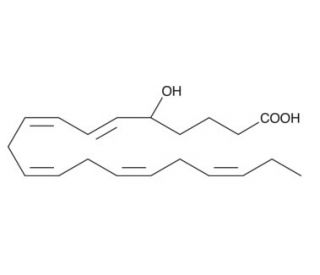

Molecular structure of (±)5-HEPE, CAS Number: 83952-40-3
(±)5-HEPE (CAS 83952-40-3)
Alternate Names:
(±)5-Hydroxy-6E,8Z,11Z,14Z,17Z-eicosapentaenoic acid
Application:
(±)5-HEPE is a compound produced by non-enzymatic oxidation of EPA
CAS Number:
83952-40-3
Molecular Weight:
318.5
Molecular Formula:
C20H30O3
Supplemental Information:
This is as a Dangerous Good for transport and may be subject to additional shipping charges.
For Research Use Only. Not Intended for Diagnostic or Therapeutic Use.
* Refer to Certificate of Analysis for lot specific data.
QUICK LINKS
Ordering Information
Description
Technical Information
Safety Information
SDS & Certificate of Analysis
(±)5-HEPE is produced by non-enzymatic oxidation of EPA resulting in a racemic mixture of 5-HEPE. The biological activity is likely mediated by one of the individual isomers, most the 5(S) isomer in mammalian systems. EPA can be metabolized to 5-HEPE in bovin and human neutrophils, as well as human eosinophils, which is further metabolized to 5-oxoEPE and LTB5. The 5-series metabolites of EPA, namely 5-HEPE, 5-oxoEPE, and LTB5, have significantly decreased biological effects compared to the arachidonic acid-derived metabolites.
(±)5-HEPE (CAS 83952-40-3) References
- 5-Hydroxy-eicosapentaenoic acid is an endogenous GPR119 agonist and enhances glucose-dependent insulin secretion. | Kogure, R., et al. 2011. Biochem Biophys Res Commun. 416: 58-63. PMID: 22079287
- Hydroxyeicosapentaenoic acids from the Pacific krill show high ligand activities for PPARs. | Yamada, H., et al. 2014. J Lipid Res. 55: 895-904. PMID: 24668940
- Hydroxyeicosapentaenoic acids and epoxyeicosatetraenoic acids attenuate early occurrence of nonalcoholic fatty liver disease. | Wang, C., et al. 2017. Br J Pharmacol. 174: 2358-2372. PMID: 28471490
- Production of lipoxygenase metabolites of eicosapentaenoic acid by bovine alveolar macrophages in vitro. | Laegreid, WW., et al. 1988. Inflammation. 12: 503-14. PMID: 2848771
- Eicosapentaenoic acid and 5-HEPE enhance macrophage-mediated Treg induction in mice. | Onodera, T., et al. 2017. Sci Rep. 7: 4560. PMID: 28676689
- Nrf2 Activation by 5-lipoxygenase Metabolites in Human Umbilical Vascular Endothelial Cells. | Nagahora, N., et al. 2017. Nutrients. 9: PMID: 28892009
- Brief Report: Markers of Spontaneous Preterm Delivery in Women Living With HIV: Relationship With Protease Inhibitors and Vitamin D. | Weinberg, A., et al. 2019. J Acquir Immune Defic Syndr. 82: 181-187. PMID: 31513074
- Analysis of oxylipins to differentiate between organic and conventional UHT milks. | Samarra, I., et al. 2021. Food Chem. 343: 128477. PMID: 33160765
- Synbiotic Compositions of Bacillus megaterium and Polyunsaturated Fatty Acid Salt Enable Self-Sufficient Production of Specialized Pro-Resolving Mediators. | Speckmann, B., et al. 2022. Nutrients. 14: PMID: 35684065
- The PNPLA3 variant I148M reveals protective effects toward hepatocellular carcinoma in mice via restoration of omega-3 polyunsaturated fats. | Patsenker, E., et al. 2022. J Nutr Biochem. 108: 109081. PMID: 35691594
- 5-HEPE reduces obesity and insulin resistance by promoting adipose tissue browning through GPR119/AMPK/PGC1α activation. | Zong, Y., et al. 2023. Life Sci. 323: 121703. PMID: 37075946
- Formation of a 5-oxo metabolite of 5,8,11,14,17-eicosapentaenoic acid and its effects on human neutrophils and eosinophils. | Powell, WS., et al. 1995. J Lipid Res. 36: 2590-8. PMID: 8847485
- Synthesis of 4- and 5-series leukotrienes in the lung microvasculature challenged with Escherichia coli hemolysin: critical dependence on exogenous free fatty acid supply. | Grimminger, F., et al. 1997. Am J Respir Cell Mol Biol. 16: 317-24. PMID: 9070617
Ordering Information
| Product Name | Catalog # | UNIT | Price | Qty | FAVORITES | |
(±)5-HEPE, 25 µg | sc-205135 | 25 µg | $47.00 | |||
(±)5-HEPE, 50 µg | sc-205135A | 50 µg | $82.00 |