
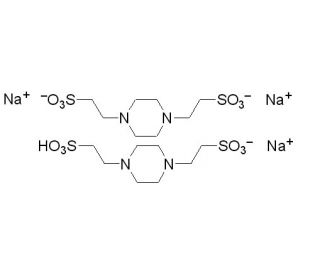

PIPES, Sesquisodium Salt (CAS 100037-69-2)
QUICK LINKS
PIPES, or Piperazine-N,N′-bis(2-ethanesulfonic acid), is a zwitterionic buffer compound extensively used in biochemical and biophysical research. It is well-regarded for its exceptional buffering capacity within the pH range of 6.1 to 7.5, making it particularly suitable for maintaining pH stability in environments sensitive to pH changes. The structure of PIPES includes a piperazine ring and two ethanesulfonic acid groups, which equip it with the ability to accept or donate protons, thereby stabilizing the pH of solutions even under varying experimental conditions. This feature is crucial in studies involving enzymatic reactions, cell culture systems, and other biological assays where slight deviations in pH can significantly impact the biological activity and stability of molecules. PIPES is predominantly utilized in cell biology for buffering cell culture media as it exhibits minimal interaction with cellular components and maintains a physiologically relevant environment. Furthermore, PIPES has been employed in various molecular biology protocols, including nucleic acid extractions and electrophoresis, where its superior buffering action ensures the integrity and stability of nucleic acids during manipulation and analysis. Its low ionic strength and minimal metal ion binding also make it an ideal choice for studies involving metal-sensitive processes, thus supporting a wide range of scientific investigations that require precise control over biochemical conditions.
PIPES, Sesquisodium Salt (CAS 100037-69-2) References
- The influence of the buffer on maintenance of tissue lipid in specimens for scanning electron microscopy. | Schiff, RI. and Gennaro, JF. 1979. Scan Electron Microsc. 449-58. PMID: 118516
- Fluorescence imaging with one nanometer accuracy: in vitro and in vivo studies of molecular motors. | Hoffman, MT., et al. 2011. Methods Mol Biol. 778: 33-56. PMID: 21809199
- Synthesis of Gold Nanoparticles with Buffer-Dependent Variations of Size and Morphology in Biological Buffers. | Ahmed, SR., et al. 2016. Nanoscale Res Lett. 11: 65. PMID: 26847691
- A RuBisCO-mediated carbon metabolic pathway in methanogenic archaea. | Kono, T., et al. 2017. Nat Commun. 8: 14007. PMID: 28082747
- Four families of folate-independent methionine synthases. | Price, MN., et al. 2021. PLoS Genet. 17: e1009342. PMID: 33534785
- A DNA tetrahedron docking assembly for imaging telomerase activity in cancerous cells. | Zhang, R., et al. 2022. Anal Chim Acta. 1193: 339395. PMID: 35058008
- Efficient Generation of Genome-wide Libraries for Protein-ligand Screens Using Gibson Assembly. | Sternlieb, T., et al. 2022. Bio Protoc. 12: PMID: 36532687
- Hydrogen ion buffers for biological research. | Good, NE., et al. 1966. Biochemistry. 5: 467-77. PMID: 5942950
- Effects of NaOH-PIPES buffer used in aldehyde fixative on alkaline phosphatase activity in rat hepatocytes. | Yamamoto, K. and Ogawa, K. 1983. Histochemistry. 77: 339-51. PMID: 6305886
- Buffers for enzymes. | Blanchard, JS. 1984. Methods Enzymol. 104: 404-14. PMID: 6717292
Ordering Information
| Product Name | Catalog # | UNIT | Price | Qty | FAVORITES | |
PIPES, Sesquisodium Salt, 100 g | sc-216100 | 100 g | $102.00 | |||
PIPES, Sesquisodium Salt, 1 kg | sc-216100A | 1 kg | $714.00 |