
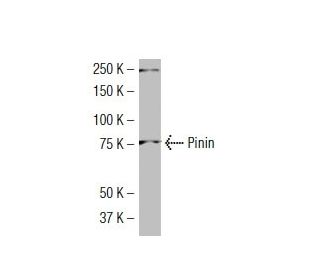

Pinin Antibody (4FQ): sc-101127
- Pinin Antibody (4FQ) is a mouse monoclonal IgG2a κ Pinin antibody provided at 100 µg/ml
- raised against recombinant Pinin of human origin
- recommended for detection of Pinin of mouse, rat and human origin by WB, IP and ELISA
- At present, we have not yet completed the identification of the preferred secondary detection reagent(s) for Pinin Antibody (4FQ). This work is in progress.

QUICK LINKS
SEE ALSO...
Pinin Antibody (4FQ) is a mouse monoclonal IgG2a kappa light chain antibody that detects Pinin protein of mouse, rat, and human origin by western blotting (WB), immunoprecipitation (IP), and enzyme-linked immunosorbent assay (ELISA). anti-Pinin antibody (4FQ) is available as the non-conjugated form. Pinin plays a crucial role in maintaining cell-to-cell adhesion within epithelial tissues, which is essential for the structural integrity and function of various organs. Pinin (4FQ) antibody localizes at desmosomes, specialized structures that mediate adhesion between adjacent cells, underscoring its importance in tissue architecture and stability. Pinin monoclonal antibody (4FQ) helps detect interactions with Cyclophilin G, a nuclear cyclophilin containing a C-terminal RS domain, highlighting Pinin′s multifaceted role in cellular processes. During early embryonic development, Pinin translocates to the nucleus, where it remains throughout development, indicating its significance in cellular differentiation and growth. Deficiencies or mutations in Pinin can lead to severe developmental defects, particularly affecting the cardiac outflow tract, axial skeleton, palate, and dorsal dermis, which can be lethal at perinatal stages. This underscores Pinin′s importance in both cellular adhesion and developmental biology, making Pinin (4FQ) monoclonal antibody a valuable research tool for studying these critical processes.
Alexa Fluor® is a trademark of Molecular Probes Inc., OR., USA
LI-COR® and Odyssey® are registered trademarks of LI-COR Biosciences
Pinin Antibody (4FQ) References:
- Antibodies differentiate desmosome-form and nucleus-form pinin: evidence that pinin is a moonlighting protein with dual location at the desmosome and within the nucleus. | Ouyang, P. 1999. Biochem Biophys Res Commun. 263: 192-200. PMID: 10486276
- Characterization of the gene encoding pinin/DRS/memA and evidence for its potential tumor suppressor function. | Shi, Y., et al. 2000. Oncogene. 19: 289-97. PMID: 10645008
- Role of cell adhesion-associated protein, pinin (DRS/memA), in corneal epithelial migration. | Shi, Y., et al. 2000. Invest Ophthalmol Vis Sci. 41: 1337-45. PMID: 10798648
- Reduction of Pnn by RNAi induces loss of cell-cell adhesion between human corneal epithelial cells. | Joo, JH., et al. 2005. Mol Vis. 11: 133-42. PMID: 15735603
- Spatial and temporal expression profile of pinin during mouse development. | Leu, S. and Ouyang, P. 2006. Gene Expr Patterns. 6: 620-31. PMID: 16427813
- Endocan is a VEGF-A and PI3K regulated gene with increased expression in human renal cancer. | Rennel, E., et al. 2007. Exp Cell Res. 313: 1285-94. PMID: 17362927
- Role of Pinin in neural crest, dorsal dermis, and axial skeleton development and its involvement in the regulation of Tcf/Lef activity in mice. | Joo, JH., et al. 2007. Dev Dyn. 236: 2147-58. PMID: 17654715
- Characterization of pinin, a novel protein associated with the desmosome-intermediate filament complex. | Ouyang, P. and Sugrue, SP. 1996. J Cell Biol. 135: 1027-42. PMID: 8922384
- Evidence that 'pinin', reportedly a differentiation-specific desmosomal protein, is actually a widespread nuclear protein. | Brandner, JM., et al. 1997. Differentiation. 62: 119-27. PMID: 9447706
Ordering Information
| Product Name | Catalog # | UNIT | Price | Qty | FAVORITES | |
Pinin Antibody (4FQ) | sc-101127 | 100 µg/ml | $339.00 |