
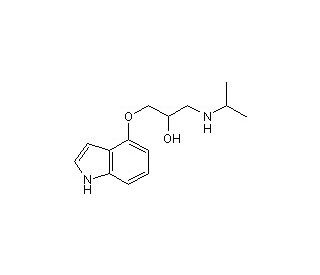

Pindolol (CAS 13523-86-9)
QUICK LINKS
Pindolol acts as an antagonist for both 5-HT1A and 5-HT1B receptors, exhibiting high affinity with Ki and IC50 values of 8.9 and 6.8 nM, respectively. Furthermore, it functions as a partial agonist for the β3 adrenoceptor with a pEC50 of 5.11. As an antagonist of β1- and β2-adrenergic receptors (β1- and β2-ARs), Pindolol binds competitively with Kis of 2.6 and 4.8 nM, respectively. Additionally, it acts as a partial agonist of the β3-AR, stimulating adenylyl cyclase when expressed in human receptor-containing cell membranes. Pindolol also functions as an antagonist of the serotonin 5-HT1A receptor, inhibiting 5-HT-stimulated GTPγS binding with a Ki value of 81.1 nM. Pindolol, an aryloxypropanolamine derivative, acts as a competitive β-adrenergic receptor blocker, resulting in reduced β-adrenergic activities such as vasodilation, negative chronotropic effects, and negative inotropic effects. Additionally, it acts as a blocker of serotonin (5-HT) 1A receptors, leading to increased availability of serotonin in the brain. This elevation in serotonin levels enhances the antidepressant action of SSRIs and monoamine oxidase inhibitors. As an indole compound, it exhibits practical insolubility in water and is relatively neutral. Pindolol has been detected in various biofluids, including urine and blood, primarily located in cell membranes. Its action pathway involves the blockade of beta-1 adrenergic receptors.
Pindolol (CAS 13523-86-9) References
- Indirect atomic absorption spectrometric determination of pindolol, propranolol and levamisole hydrochlorides based on formation of ion-associates with ammonium reineckate and sodium cobaltinitrite. | Khalil, S. and Borham, N. 2000. J Pharm Biomed Anal. 22: 235-40. PMID: 10719905
- Pindolol augmentation in patients with treatment-resistant panic disorder: A double-blind, placebo-controlled trial. | Hirschmann, S., et al. 2000. J Clin Psychopharmacol. 20: 556-9. PMID: 11001241
- Differential occupancy of somatodendritic and postsynaptic 5HT(1A) receptors by pindolol: a dose-occupancy study with [11C]WAY 100635 and positron emission tomography in humans. | Martinez, D., et al. 2001. Neuropsychopharmacology. 24: 209-29. PMID: 11166513
- Factors affecting fluvoxamine antidepressant activity: influence of pindolol and 5-HTTLPR in delusional and nondelusional depression. | Zanardi, R., et al. 2001. Biol Psychiatry. 50: 323-30. PMID: 11543734
- Pindolol potentiation of paroxetine for generalized social phobia: a double-blind, placebo-controlled, crossover study. | Stein, MB., et al. 2001. Am J Psychiatry. 158: 1725-7. PMID: 11579011
- Pindolol augmentation of selective serotonin reuptake inhibitors: PET evidence that the dose used in clinical trials is too low. | Rabiner, EA., et al. 2001. Am J Psychiatry. 158: 2080-2. PMID: 11729033
- Effectiveness of pindolol plus serotonin uptake inhibitors in depression: a meta-analysis of early and late outcomes from randomised controlled trials. | Ballesteros, J. and Callado, LF. 2004. J Affect Disord. 79: 137-47. PMID: 15023488
- Cross-linked alginate-gelatine beads: a new matrix for controlled release of pindolol. | Ferreira Almeida, P. and Almeida, AJ. 2004. J Control Release. 97: 431-9. PMID: 15212875
- Effects of desipramine and tramadol in a chronic mild stress model in mice are altered by yohimbine but not by pindolol. | Yalcin, I., et al. 2005. Eur J Pharmacol. 514: 165-74. PMID: 15910803
- Pindolol augmentation enhances response outcomes in first depressive episodes. | Portella, MJ., et al. 2009. Eur Neuropsychopharmacol. 19: 516-9. PMID: 19419845
- Can we really accelerate and enhance the selective serotonin reuptake inhibitor antidepressant effect? A randomized clinical trial and a meta-analysis of pindolol in nonresistant depression. | Portella, MJ., et al. 2011. J Clin Psychiatry. 72: 962-9. PMID: 21034693
- Electroanalytical detection of pindolol: comparison of unmodified and reduced graphene oxide modified screen-printed graphite electrodes. | Cumba, LR., et al. 2015. Analyst. 140: 1543-50. PMID: 25610919
- Structural and conformational features determining selective signal transduction in the beta 3-adrenergic receptor. | Blin, N., et al. 1993. Mol Pharmacol. 44: 1094-104. PMID: 7903415
- International Union of Pharmacology classification of receptors for 5-hydroxytryptamine (Serotonin). | Hoyer, D., et al. 1994. Pharmacol Rev. 46: 157-203. PMID: 7938165
- Electrophysiological and neurochemical evidence that pindolol has agonist properties at the 5-HT1A autoreceptor in vivo. | Clifford, EM., et al. 1998. Br J Pharmacol. 124: 206-12. PMID: 9630361
Ordering Information
| Product Name | Catalog # | UNIT | Price | Qty | FAVORITES | |
Pindolol, 100 mg | sc-204847 | 100 mg | $194.00 | |||
Pindolol, 1 g | sc-204847A | 1 g | $760.00 |