
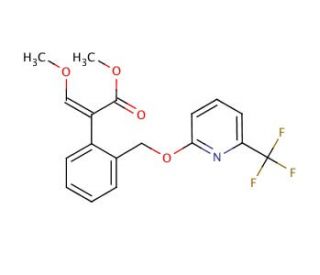

Picoxystrobin (CAS 117428-22-5)
QUICK LINKS
Picoxystrobin is a synthetic fungicide belonging to the strobilurin class, widely used in agriculture to protect crops from various fungal diseases. It functions by inhibiting mitochondrial respiration in fungal cells, specifically targeting the cytochrome bc1 complex at the Qo site within the mitochondrial electron transport chain. This inhibition blocks the electron transfer, halting ATP production, and ultimately leading to the cessation of fungal growth and cell death. The specificity of picoxystrobin for this site makes it highly effective against a broad spectrum of fungi, contributing significantly to its popularity in managing diseases in crops like cereals, fruits, and vegetables. Research into picoxystrobin has explored its environmental fate, resistance patterns in fungal populations, and efficacy under different environmental conditions, providing valuable data for optimizing its use in integrated pest management systems. These studies help ensure that picoxystrobin remains an effective tool in sustainable agriculture, minimizing potential resistance and environmental impact while maximizing crop yield and quality.
Picoxystrobin (CAS 117428-22-5) References
- Effects of picoxystrobin and 4-n-nonylphenol on soil microbial community structure and respiration activity. | Stenrød, M., et al. 2013. PLoS One. 8: e66989. PMID: 23818971
- Thiamethoxam and picoxystrobin reduce the survival and overload the hepato-nephrocitic system of the Africanized honeybee. | Domingues, CEC., et al. 2017. Chemosphere. 186: 994-1005. PMID: 28835008
- Effects of two strobilurins (azoxystrobin and picoxystrobin) on embryonic development and enzyme activities in juveniles and adult fish livers of zebrafish (Danio rerio). | Jia, W., et al. 2018. Chemosphere. 207: 573-580. PMID: 29843034
- Residue analysis of picoxystrobin in oriental melon using gas chromatography coupled with electron capture detection and mass spectrometric confirmation: application to dissipation kinetics and risk assessment. | Kabir, MH., et al. 2017. Food Sci Biotechnol. 26: 1145-1153. PMID: 30263647
- Residue determination of pyraclostrobin, picoxystrobin and its metabolite in pepper fruit via UPLC-MS/MS under open field conditions. | Gao, Y., et al. 2019. Ecotoxicol Environ Saf. 182: 109445. PMID: 31330408
- Magnitude of picoxystrobin residues in strawberry under Egyptian conditions: dissipation pattern and consumer risk assessment. | Malhat, F., et al. 2020. Food Addit Contam Part A Chem Anal Control Expo Risk Assess. 37: 973-982. PMID: 32186993
- Dissipation, residues and risk assessment of pyraclostrobin and picoxystrobin in cucumber under field conditions. | Zhao, H., et al. 2020. J Sci Food Agric. 100: 5145-5151. PMID: 32519755
- Residue dissipation, transfer and safety evaluation of picoxystrobin during tea growing and brewing. | Zhang, X., et al. 2021. J Sci Food Agric. 101: 194-204. PMID: 32623719
- Ecotoxicology of strobilurin fungicides. | Zhang, C., et al. 2020. Sci Total Environ. 742: 140611. PMID: 32721740
- Residue analysis and dietary risk assessment of picoxystrobin in potato (Solanum tuberosum), citrus fruit (Citrus reticulata Blanco), and Dendrobium officinale Kimura et Migo. | Dou, W., et al. 2024. J Environ Sci Health B. 59: 152-159. PMID: 38347689
Ordering Information
| Product Name | Catalog # | UNIT | Price | Qty | FAVORITES | |
Picoxystrobin, 100 mg | sc-224206 | 100 mg | $55.00 |