
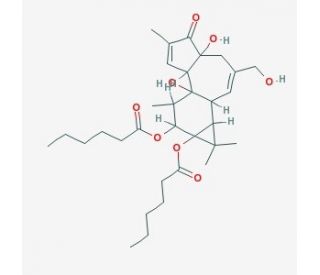

Phorbol 12, 13-Dihexanoate (CAS 37558-17-1)
See product citations (2)
QUICK LINKS
Phorbol-12,13-dihexanoate (PDD) is a synthetic compound derived from phorbol ester, a natural substance found in Croton tiglium seeds. Widely utilized in scientific research, Phorbol 12, 13-Dihexanoate exhibits the remarkable ability to activate protein kinase C (PKC) and elicit cellular responses. Its versatile applications span across cancer research, neuroscience, and immunology. By acting as a potent PKC activator, Phorbol-12,13-dihexanoate plays a pivotal role in various cellular processes, including cell proliferation, differentiation, and apoptosis. In cancer research, Phorbol-12,13-dihexanoate has demonstrated its capability to induce apoptosis in cancer cells through the activation of PKC and subsequent activation of downstream signaling pathways. In neuroscience, it has been employed to investigate the involvement of PKC in synaptic plasticity and memory formation within the brain. Similarly, in the realm of immunology, Phorbol-12,13-dihexanoate has been utilized to activate PKC in T cells, facilitating the study of signaling pathways governing T cell activation and differentiation. Activation of PKC by Phorbol-12,13-dihexanoate occurs through its binding to the C1 domain of PKC, leading to a conformational change and translocation of PKC to the plasma membrane. Upon reaching the membrane, PKC undergoes phosphorylation, enabling it to phosphorylate downstream targets, including transcription factors and ion channels. The downstream effects of PKC activation are contingent upon the specific isoform of PKC involved and the cellular context.
Phorbol 12, 13-Dihexanoate (CAS 37558-17-1) References
- The lipophilicity of phorbol esters as a critical factor in determining the pattern of translocation of protein kinase C delta fused to green fluorescent protein. | Wang, QJ., et al. 2000. J Biol Chem. 275: 12136-46. PMID: 10766849
- Activation mechanisms of protein kinase C: maturation, catalytic activation, and targeting. | Shirai, Y. and Saito, N. 2002. J Biochem. 132: 663-8. PMID: 12417013
- Differential irreversible insertion of protein kinase C into phospholipid vesicles by phorbol esters and related activators. | Kazanietz, MG., et al. 1992. J Biol Chem. 267: 20878-86. PMID: 1400402
- Analysis by fluorescence resonance energy transfer of the interaction between ligands and protein kinase Cdelta in the intact cell. | Braun, DC., et al. 2005. J Biol Chem. 280: 8164-71. PMID: 15611119
- Some phorbol esters might partially resemble bryostatin 1 in their actions on LNCaP prostate cancer cells and U937 leukemia cells. | Kedei, N., et al. 2011. Chembiochem. 12: 1242-51. PMID: 21542090
- Specific binding of [20-3H]12-deoxyphorbol 13-isobutyrate to phorbol ester receptor subclasses in mouse skin particulate preparations. | Dunn, JA. and Blumberg, PM. 1983. Cancer Res. 43: 4632-7. PMID: 6309373
Ordering Information
| Product Name | Catalog # | UNIT | Price | Qty | FAVORITES | |
Phorbol 12, 13-Dihexanoate, 1 mg | sc-203421 | 1 mg | $79.00 |