
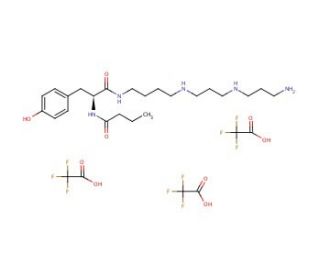

Philanthotoxin 433 tris(trifluoroacetate) salt (CAS 276684-27-6)
See product citations (9)
QUICK LINKS
Philanthotoxin 433 tris(trifluoroacetate) salt, often abbreviated as PhTX-433, is a polyamine-containing toxin found in the venom of the wasp Philanthus triangulum. It is known for its specific action on ion channels, particularly its inhibition of NMDA (N-methyl-D-aspartate) receptors, which are for synaptic transmission and plasticity in the central nervous system. This toxin operates by binding to the open channel form of NMDA receptors, thereby obstructing the flow of ions such as calcium, sodium, and potassium across the cell membrane. This blockade can modulate the receptor′s function, makingPhilanthotoxin 433 tris(trifluoroacetate) salt useful in neurophysiological research for understanding synaptic processes, the mechanisms underlying excitatory neurotransmission, and the pathophysiology of diseases characterized by NMDA receptor dysfunction. Its utility in research extends to the exploration of the structural and functional dynamics of ion channels, contributing to the broader field of neuropharmacology and the development of strategies for targeting these channels in various neurological conditions.
Philanthotoxin 433 tris(trifluoroacetate) salt (CAS 276684-27-6) References
- Effects of philanthotoxin-343 on CA1 pyramidal neurons of rat hippocampus in vitro. | Fedorov, NB., et al. 1992. Eur J Pharmacol. 228: 201-6. PMID: 1282467
- Inhibition of dipteran larval neuromuscular synaptic transmission by analogues of philanthotoxin-4.3.3: a structure-activity study. | Benson, JA., et al. 1992. Comp Biochem Physiol C Comp Pharmacol Toxicol. 102: 267-72. PMID: 1358540
- Differential regulation of metabotropic glutamate receptor- and AMPA receptor-mediated dendritic Ca2+ signals by presynaptic and postsynaptic activity in hippocampal interneurons. | Topolnik, L., et al. 2005. J Neurosci. 25: 990-1001. PMID: 15673681
- Age-dependent participation of Ras-GRF proteins in coupling calcium-permeable AMPA glutamate receptors to Ras/Erk signaling in cortical neurons. | Tian, X. and Feig, LA. 2006. J Biol Chem. 281: 7578-82. PMID: 16407208
- Metabotropic glutamate receptors modulate the NMDA- and AMPA-induced gene expression in neocortical interneurons. | Lindemeyer, K., et al. 2006. Cereb Cortex. 16: 1662-77. PMID: 16407481
- Glia-dependent switch of kainate receptor presynaptic action. | Bonfardin, VD., et al. 2010. J Neurosci. 30: 985-95. PMID: 20089907
- Functional architecture of olfactory ionotropic glutamate receptors. | Abuin, L., et al. 2011. Neuron. 69: 44-60. PMID: 21220098
- Kainate receptor-induced retrograde inhibition of glutamatergic transmission in vasopressin neurons. | Bonfardin, VD., et al. 2012. J Neurosci. 32: 1301-10. PMID: 22279215
- Molecular mechanisms that stabilize short term synaptic plasticity during presynaptic homeostatic plasticity. | Ortega, JM., et al. 2018. Elife. 7: PMID: 30422113
- Dual separable feedback systems govern firing rate homeostasis. | Kulik, Y., et al. 2019. Elife. 8: PMID: 30973325
- Target-wide Induction and Synapse Type-Specific Robustness of Presynaptic Homeostasis. | Genç, Ö. and Davis, GW. 2019. Curr Biol. 29: 3863-3873.e2. PMID: 31708391
- Presynaptic Homeostasis Opposes Disease Progression in Mouse Models of ALS-Like Degeneration: Evidence for Homeostatic Neuroprotection. | Orr, BO., et al. 2020. Neuron. 107: 95-111.e6. PMID: 32380032
- Active zone compaction correlates with presynaptic homeostatic potentiation. | Mrestani, A., et al. 2021. Cell Rep. 37: 109770. PMID: 34610300
- Endogenous tagging of Unc-13 reveals nanoscale reorganization at active zones during presynaptic homeostatic potentiation. | Dannhäuser, S., et al. 2022. Front Cell Neurosci. 16: 1074304. PMID: 36589286
- Selective antagonism of native and cloned kainate and NMDA receptors by polyamine-containing toxins. | Brackley, PT., et al. 1993. J Pharmacol Exp Ther. 266: 1573-80. PMID: 7690404
- Philanthotoxin inhibits Ca2+ currents in rat hippocampal CA1 neurons. | Karst, H., et al. 1994. Eur J Pharmacol. 270: 357-60. PMID: 7805785
Ordering Information
| Product Name | Catalog # | UNIT | Price | Qty | FAVORITES | |
Philanthotoxin 433 tris(trifluoroacetate) salt, 1 mg | sc-255421 | 1 mg | $612.00 |