
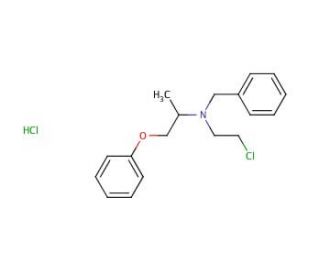

Phenoxybenzamine (CAS 63-92-3)
Vedere citazioni di prodotto (4)
LINK RAPIDI
La fenossibenzamina è utilizzata nella ricerca fisiologica, in particolare per la sua capacità di bloccare irreversibilmente i recettori alfa-adrenergici. Questo blocco è utile per gli studi incentrati sul sistema nervoso simpatico e sul suo ruolo nella regolazione del tono vascolare e della pressione sanguigna. La capacità della fenossibenzamina di indurre vasodilatazione la rende utile per studiare la fisiopatologia delle malattie caratterizzate da eccessiva vasocostrizione e ipertensione. Inoltre, viene utilizzata nella ricerca per esplorare i meccanismi di rilascio delle catecolamine e le dinamiche dei recettori in varie condizioni fisiologiche e patologiche. Inoltre, la fenossibenzamina viene utilizzata in studi che esaminano gli effetti dell'inibizione dei recettori adrenergici sulla funzione muscolare liscia, contribuendo a una più ampia comprensione della regolazione autonomica.
Phenoxybenzamine (CAS 63-92-3) Referenze
- La fenossibenzamina nella gestione della disfunzione vescicale neurogena. | Mobley, DF. 1976. J Urol. 116: 737-8. PMID: 1003641
- La fenossibenzamina è più efficace e meno dannosa della papaverina nella prevenzione del vasospasmo dell'arteria radiale. | Dipp, MA., et al. 2001. Eur J Cardiothorac Surg. 19: 482-6. PMID: 11306317
- Il legame con la fenossibenzamina rivela l'orientamento elicoidale del terzo dominio transmembrana dei recettori adrenergici. | Frang, H., et al. 2001. J Biol Chem. 276: 31279-84. PMID: 11395517
- Profilo pressorio uretrale ed effetti emodinamici di fenossibenzamina e prazosina in cani beagle maschi non sedati. | Fischer, JR., et al. 2003. Can J Vet Res. 67: 30-8. PMID: 12528826
- Recenti sviluppi nella terapia del feocromocitoma. | Chew, SL. 2004. Expert Opin Investig Drugs. 13: 1579-83. PMID: 15566315
- Trattamento della sindrome da dolore regionale complesso di tipo I con fenossibenzamina orale: razionale e casi clinici. | Inchiosa, MA. and Kizelshteyn, G. 2008. Pain Pract. 8: 125-32. PMID: 18194348
- Il trattamento con fenossibenzamina può portare alla perdita di vitalità delle cellule endoteliali. | Pai, KR., et al. 2008. Interact Cardiovasc Thorac Surg. 7: 916-8. PMID: 18573847
- Inibizione della guanililciclasi attivata dall'ossido nitrico da parte di antagonisti della calmodulina. | James, LR., et al. 2009. Br J Pharmacol. 158: 1454-64. PMID: 19845679
- La fenossibenzamina è neuroprotettiva in un modello di ratto di grave lesione cerebrale traumatica. | Rau, TF., et al. 2014. Int J Mol Sci. 15: 1402-17. PMID: 24447929
- Confronto tra fenossibenzamina e doxazosina nella gestione perioperatoria dei pazienti con feocromocitoma. | Malec, K., et al. 2017. Kardiol Pol. 75: 1192-1198. PMID: 28715066
- Attività antitumorale della fenossibenzamina e sua inibizione delle istone deacetilasi. | Inchiosa, MA. 2018. PLoS One. 13: e0198514. PMID: 29897996
- Confronto dell'alfa-blocco preoperatorio per la resezione del paraganglioma e del feocromocitoma. | Zhu, CY., et al. 2022. Endocr Pract. 28: 889-896. PMID: 35809774
- Interazione degli antagonisti alfa adrenergici con la calmodulina. | Earl, CQ., et al. 1984. Life Sci. 35: 525-34. PMID: 6146911
- Fenossibenzamina per il trattamento della diarrea grave non responsiva nel cavallo. | Hood, DM., et al. 1982. J Am Vet Med Assoc. 180: 758-62. PMID: 7085456
- Prove in vivo della generazione di un complesso recettore glucocorticoide-proteina da shock termico-90 incapace di legare l'ormone da parte dell'antagonista della calmodulina fenossibenzamina. | Ning, YM. and Sánchez, ER. 1996. Mol Endocrinol. 10: 14-23. PMID: 8838141
Informazioni ordini
| Nome del prodotto | Codice del prodotto | UNITÀ | Prezzo | Quantità | Preferiti | |
Phenoxybenzamine, 200 mg | sc-3581 | 200 mg | $23.00 | |||
Phenoxybenzamine, 1 g | sc-3581A | 1 g | $77.00 |