
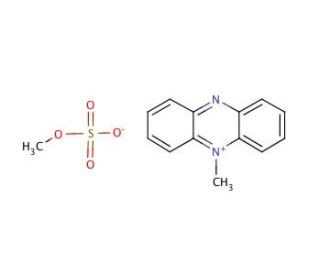

Phenazine methosulfate (CAS 299-11-6)
See product citations (6)
QUICK LINKS
Phenazine methosulfate (PMS) is a versatile redox-active dye extensively employed in scientific research. Its wide range of applications includes the determination of nitric oxide reductase activity when used alongside ascorbic acid. In the hexosemonophosphate system, Phenazine methosulfate serves as an electron carrier, replacing the flavine enzyme of Warburg. Furthermore, it finds utility in the preparation of succinic dehydrogenase. Phenazine methosulfate has been instrumental in studying the redox properties of proteins, biomolecules, and exploring enzyme kinetics and mechanisms of action. Its efficacy extends to a variety of scientific research applications. In vivo experiments employ living organisms or tissues to investigate the effects of Phenazine methosulfate on biological systems. In contrast, in vitro experiments utilize isolated cells or tissues to examine the impact of Phenazine methosulfate on biochemical or physiological processes. Functioning as both an electron acceptor and donor, Phenazine methosulfate exhibits redox activity. Its behavior as an oxidizing agent, reducing agent, or both is contingent upon the surrounding environment. Although the precise mechanism of action of Phenazine methosulfate is still under investigation, current understanding suggests its involvement in electron transfer between molecules and the generation of reactive oxygen species. Phenazine methosulfate stands as a vital tool in scientific research, enabling advancements in the understanding of redox processes, enzyme kinetics, and related areas of study. Ongoing investigations aim to unravel the full potential of Phenazine methosulfate, shedding light on its mechanism of action and exploring its future applications in diverse scientific disciplines.
Phenazine methosulfate (CAS 299-11-6) References
- Molecular basis for enhanced biosynthesis of clavulanic acid by a redox-cycling agent, phenazine methosulfate, in Streptomyces clavuligerus. | Kwon, HJ. and Kim, SU. 1999. Appl Microbiol Biotechnol. 53: 57-62. PMID: 10645626
- Testosterone 5 alpha-reductase inhibitors, menaquinone 7 produced by a Bacillus and phenazine methosulfate. | Kim, YU., et al. 1999. Biol Pharm Bull. 22: 1396-9. PMID: 10746179
- Phenazine methosulfate decreases HIF-1α accumulation during the exposure of cells to hypoxia. | Yamaki, A. and Muratsubaki, H. 2012. Biosci Biotechnol Biochem. 76: 1682-7. PMID: 23006579
- Effect of phenazine methosulfate on electrophysiological activity of the semicircular canal: antioxidant properties of trimetazidine. | Aubert, A., et al. 1989. Eur J Pharmacol. 174: 215-25. PMID: 2630299
- Nitrate reductase activity test: phenazine methosulfate-ferricyanide stop reagent replaces postassay treatment. | Scheideler, L. and Ninnemann, H. 1986. Anal Biochem. 154: 29-33. PMID: 2939767
- The characterization of phenazine methosulfate stimulated insulin secretion. | Akpan, JO., et al. 1987. Acta Diabetol Lat. 24: 65-78. PMID: 2956817
- Cytotoxicity of phenazine methosulfate in isolated rat hepatocytes is associated with superoxide anion production, thiol oxidation and alterations in intracellular calcium ion homeostasis. | Maridonneau-Parini, I., et al. 1986. Toxicol Lett. 31: 175-81. PMID: 3012828
- Repurposing the Electron Transfer Reactant Phenazine Methosulfate (PMS) for the Apoptotic Elimination of Malignant Melanoma Cells through Induction of Lethal Oxidative and Mitochondriotoxic Stress. | Hua, AB., et al. 2019. Cancers (Basel). 11: PMID: 31035569
- Fluorescent redox-dependent labeling of lipid droplets in cultured cells by reduced phenazine methosulfate. | Stockert, JC., et al. 2020. Heliyon. 6: e04182. PMID: 32566788
- Phenazine methosulfate induces a neurally-mediated contraction of the guinea-pig ileum. | Hanani, M. and Nissan, S. 1986. Life Sci. 39: 1805-12. PMID: 3773643
- Inhibition by superoxide dismutase and catalase of the damage of isolated Leishmania mexicana amazonensis by phenazine methosulfate. | Nabi, ZF. and Rabinovitch, M. 1984. Mol Biochem Parasitol. 10: 297-303. PMID: 6328296
- Effect of ammonia, darkness, and phenazine methosulfate on whole-cell nitrogenase activity and Fe protein modification in Rhodospirillum rubrum. | Kanemoto, RH. and Ludden, PW. 1984. J Bacteriol. 158: 713-20. PMID: 6427184
- Electrochemical bioreactor with immobilized glucose-6-phosphate dehydrogenase on the rotating graphite disc electrode modified with phenazine methosulfate. | Miyawaki, O. and Yano, T. 1993. Enzyme Microb Technol. 15: 525-9. PMID: 7763682
- Reactive oxygen species involved in phenazine-methosulfate-induced rat lens opacification. An experimental model of cataract. | Kise, K., et al. 1994. Ophthalmic Res. 26: 41-50. PMID: 8134088
Ordering Information
| Product Name | Catalog # | UNIT | Price | Qty | FAVORITES | |
Phenazine methosulfate, 500 mg | sc-215700 | 500 mg | $46.00 | |||
Phenazine methosulfate, 1 g | sc-215700A | 1 g | $66.00 | |||
Phenazine methosulfate, 5 g | sc-215700B | 5 g | $245.00 |