
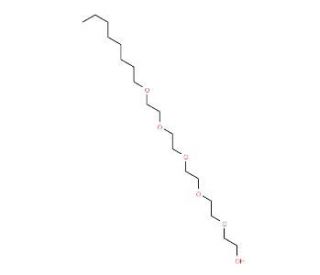

Pentaethylene glycol monooctyl ether (CAS 19327-40-3)
QUICK LINKS
Pentaethylene glycol monooctyl ether, a nonionic surfactant from the polyethylene glycol ethers family, is distinguished by its molecular structure which combines a hydrophobic octyl group with a hydrophilic sequence of five ethylene glycol units. This configuration confers the compound excellent ability to reduce surface and interfacial tensions, making it an effective agent in stabilizing emulsions and dispersions. Its mode of action involves the orientation of its hydrophilic glycol chain towards water and its hydrophobic tail towards oils, effectively facilitating the blending of immiscible liquids. In research, pentaethylene glycol monooctyl ether is widely used to stabilize nanoparticles and colloidal systems, preventing aggregation and ensuring uniformity in particle size distribution, which is crucial for the reliable synthesis and application of nanomaterials. Additionally, its surfactant properties are utilized in environmental science for enhancing phase separation processes in water treatment technologies. The compound′s ability to mediate between hydrophilic and hydrophobic phases also makes it a valuable tool in polymer chemistry, aiding in the formulation of complex polymeric structures that require precise control over molecular interactions and properties. Through these applications, pentaethylene glycol monooctyl ether plays a vital role in advancing research and development across various scientific fields.
Pentaethylene glycol monooctyl ether (CAS 19327-40-3) References
- S. aureus MscL is a pentamer in vivo but of variable stoichiometries in vitro: implications for detergent-solubilized membrane proteins. | Dorwart, MR., et al. 2010. PLoS Biol. 8: e1000555. PMID: 21151884
- The variable detergent sensitivity of proteases that are utilized for recombinant protein affinity tag removal. | Vergis, JM. and Wiener, MC. 2011. Protein Expr Purif. 78: 139-42. PMID: 21539919
- Molecular architecture and functional analysis of NetB, a pore-forming toxin from Clostridium perfringens. | Savva, CG., et al. 2013. J Biol Chem. 288: 3512-22. PMID: 23239883
- Binary Toxin Subunits of Lysinibacillus sphaericus Are Monomeric and Form Heterodimers after In Vitro Activation. | Surya, W., et al. 2016. PLoS One. 11: e0158356. PMID: 27341696
- Structure of the core of the type III secretion system export apparatus. | Kuhlen, L., et al. 2018. Nat Struct Mol Biol. 25: 583-590. PMID: 29967543
- Crystal structures of the GH18 domain of the bifunctional peroxiredoxin-chitinase CotE from Clostridium difficile. | Whittingham, JL., et al. 2020. Acta Crystallogr F Struct Biol Commun. 76: 241-249. PMID: 32510464
- Influence of Temperature and Concentration on the Self-Assembly of Nonionic CiEj Surfactants: A Light Scattering Study. | Kroll, P., et al. 2022. ACS Omega. 7: 7057-7065. PMID: 35252696
- A general protocol for the expression and purification of the intact transmembrane transporter FeoB. | Sestok, AE., et al. 2022. Biochim Biophys Acta Biomembr. 1864: 183973. PMID: 35636558
- Crystal structure of the membrane (M) protein from a bat betacoronavirus. | Wang, X., et al. 2023. PNAS Nexus. 2: pgad021. PMID: 36874273
- The multistep oxidation of cholesterol to pregnenolone by human cytochrome P450 11A1 is highly processive. | McCarty, KD., et al. 2024. J Biol Chem. 300: 105495. PMID: 38006947
Ordering Information
| Product Name | Catalog # | UNIT | Price | Qty | FAVORITES | |
Pentaethylene glycol monooctyl ether, 1 g | sc-281126 | 1 g | $192.00 | |||
Pentaethylene glycol monooctyl ether, 5 g | sc-281126A | 5 g | $758.00 |