
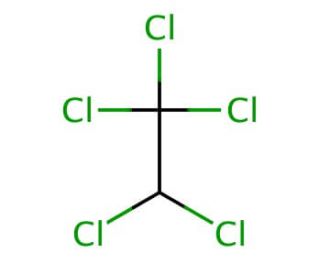

Pentachloroethane (CAS 76-01-7)
QUICK LINKS
Pentachloroethane is a chemical compound that functions as a solven. It acts as a reactant in certain chemical reactions, particularly in the production of other organic compounds. Its mechanism of action involves participating in substitution reactions, where it can replace hydrogen atoms in organic molecules. This substitution reaction allows for the synthesis of various organic compounds with specific functional groups. Pentachloroethane′s role in these reactions is to facilitate the formation of new chemical bonds and contribute to the creation of complex organic molecules. Its mechanism of action at the molecular level involves interacting with other reagents to bring about chemical transformations, enabling the synthesis of diverse organic compounds for experimental purposes.
Pentachloroethane (CAS 76-01-7) References
- Dechlorination of pentachloroethane by commercial Fe and ferruginous smectite. | Cervini-Silva, J., et al. 2002. Chemosphere. 47: 971-6. PMID: 12108704
- Dehydrochlorination of 1,1,1-trichloroethane and pentachloroethane by microbially reduced ferruginous smectite. | Cervini-Silva, J., et al. 2003. Environ Toxicol Chem. 22: 1046-50. PMID: 12729213
- Carcinogenesis Studies of Pentachloroethane (CAS No. 76-01-7) in F344/N Rats and B6C3F1 Mice (Gavage Study). | ,. 1983. Natl Toxicol Program Tech Rep Ser. 232: 1-149. PMID: 12778204
- Total degradation of pentachloroethane by an engineered Alcaligenes strain expressing a modified camphor monooxygenase and a hybrid dioxygenase. | Iwakiri, R., et al. 2004. Biosci Biotechnol Biochem. 68: 1353-6. PMID: 15215602
- Oxygenases and dehalogenases: molecular approaches to efficient degradation of chlorinated environmental pollutants. | Furukawa, K. 2006. Biosci Biotechnol Biochem. 70: 2335-48. PMID: 17031039
- Reactions with pentachloroethane; hydrochlorination of ephedrine. | MILLER, CE. 1948. J Am Pharm Assoc Am Pharm Assoc. 37: 226. PMID: 18865171
- Mechanism of base-promoted dehydrochlorination of pentachloroethane: concerted or stepwise? | Liu, X. and Meijer, EJ. 2009. J Phys Chem A. 113: 3542-4. PMID: 19309129
- Tetrachloroethane, pentachloroethane, and hexachloroethane: genetic and biochemical studies. | Bronzetti, G., et al. 1989. Teratog Carcinog Mutagen. 9: 349-57. PMID: 2576814
- Metabolic activation and covalent binding to nucleic acids of pentachloroethane as short-term test of genotoxicity. | Turina, MP., et al. 1989. Res Commun Chem Pathol Pharmacol. 63: 81-91. PMID: 2916082
- Metabolism of pentachloroethane in the mouse. | Yllner, S. 1971. Acta Pharmacol Toxicol (Copenh). 29: 481-9. PMID: 5171121
- Studies on the carcinogenicity of pentachloroethane in rats and mice. | Mennear, JH., et al. 1982. Fundam Appl Toxicol. 2: 82-7. PMID: 7185606
- Recruitment of co-metabolic enzymes for environmental detoxification of organohalides. | Wackett, LP. 1995. Environ Health Perspect. 103 Suppl 5: 45-8. PMID: 8565909
- Enzyme-catalyzed dehalogenation of pentachloroethane: why F87W-cytochrome P450cam is faster than wild type. | Manchester, JI. and Ornstein, RL. 1995. Protein Eng. 8: 801-7. PMID: 8637849
- Distal site and surface mutations of cytochrome P450 1A2 markedly enhance dehalogenation of chlorinated hydrocarbons. | Yanagita, K., et al. 1997. Arch Biochem Biophys. 346: 269-76. PMID: 9343374
Ordering Information
| Product Name | Catalog # | UNIT | Price | Qty | FAVORITES | |
Pentachloroethane, 250 mg | sc-257973 | 250 mg | $57.00 |