
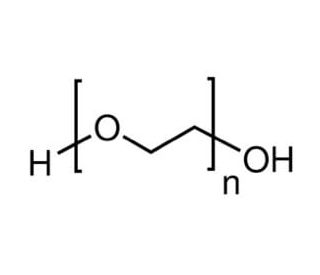

Molecular structure of PEG 10000, CAS Number: 25322-68-3
PEG 10000 (CAS 25322-68-3)
Alternate Names:
Poly(ethylene glycol)
Application:
PEG 10000 is a compound used to modify therapeutic proteins and peptides to increase their solubility
CAS Number:
25322-68-3
Molecular Weight:
~10000
Molecular Formula:
H(OCH2CH2)nOH
For Research Use Only. Not Intended for Diagnostic or Therapeutic Use.
* Refer to Certificate of Analysis for lot specific data.
QUICK LINKS
Ordering Information
Description
Technical Information
Safety Information
SDS & Certificate of Analysis
PEG 10000 is a polymer of ethylene oxide. This specific compound has a MW average of 10,000. PEG 10000 is a compound used to modify therapeutic proteins and peptides to increase their solubility. It is often used as a polar stationary phase for Gas Chromatorgraphy. Commonly also used in mass spec experiments. It is also used to preserve objects that have been retrieved from the ocean.
PEG 10000 (CAS 25322-68-3) References
- Effect of drug solubility and different excipients on floating behaviour and release from glyceryl monooleate matrices. | Kumar M, K., et al. 2004. Int J Pharm. 272: 151-60. PMID: 15019078
- A hemolysin from the mushroom Pleurotus eryngii. | Ngai, PH. and Ng, TB. 2006. Appl Microbiol Biotechnol. 72: 1185-91. PMID: 16804695
- Solvent systems for countercurrent chromatography: an aqueous two phase liquid system based on a room temperature ionic liquid. | Ruiz-Angel, MJ., et al. 2007. J Chromatogr A. 1151: 65-73. PMID: 17166506
- A new and selective and sensitive nanogold-labeled immunoresoance scattering spectral assay for trace prealbumin. | Hou, M., et al. 2007. Talanta. 72: 463-7. PMID: 19071641
- Hydrothermal synthesis of Ni(12)P(5) hollow microspheres, characterization and photocatalytic degradation property. | Li, J., et al. 2009. J Colloid Interface Sci. 332: 231-6. PMID: 19144350
- Poly(ethylene glycol)-modified gold nanorods as a photothermal nanodevice for hyperthermia. | Niidome, T., et al. 2009. J Biomater Sci Polym Ed. 20: 1203-15. PMID: 19520008
- Biosolubilization of rock phosphate by three stress-tolerant fungal strains. | Xiao, C., et al. 2011. Appl Biochem Biotechnol. 165: 719-27. PMID: 21625871
- Bioinspired insights into silicic acid stabilization mechanisms: the dominant role of polyethylene glycol-induced hydrogen bonding. | Preari, M., et al. 2014. J Am Chem Soc. 136: 4236-44. PMID: 24564240
- Fused silica capillaries with two segments of different internal diameters and inner surface roughnesses prepared by etching with supercritical water and used for volume coupling electrophoresis. | Horká, M., et al. 2017. Electrophoresis. 38: 1260-1267. PMID: 28229522
- Fabrication of β-conglycinin-stabilized nanoemulsions via ultrasound process and influence of SDS and PEG 10000 co-emulsifiers on the physicochemical properties of nanoemulsions. | Jin, H., et al. 2018. Food Res Int. 106: 800-808. PMID: 29579989
- Evaluation of microneedles-assisted in situ depot forming poloxamer gels for sustained transdermal drug delivery. | Khan, S., et al. 2019. Drug Deliv Transl Res. 9: 764-782. PMID: 30675693
- PEG/Sodium Tripolyphosphate-Modified Chitosan/Activated Carbon Membrane for Rhodamine B Removal. | Yang, J., et al. 2021. ACS Omega. 6: 15885-15891. PMID: 34179632
- Development of the Binary and Ternary Atorvastatin Solid Dispersions: In Vitro and In Vivo Investigations. | Faraji, E., et al. 2021. Biomed Res Int. 2021: 6644630. PMID: 34527740
- Immobilization of α-amylase in ethylcellulose electrospun fibers using emulsion-electrospinning method. | Hosseini, A., et al. 2022. Carbohydr Polym. 278: 118919. PMID: 34973738
- Enhanced loading and activity retention of bioactive proteins in hydrogel delivery systems. | Gehrke, SH., et al. 1998. J Control Release. 55: 21-33. PMID: 9795005
Ordering Information
| Product Name | Catalog # | UNIT | Price | Qty | FAVORITES | |
PEG 10000, 500 g | sc-362504 | 500 g | $79.00 | |||
PEG 10000, 1 kg | sc-362504B | 1 kg | $124.00 | |||
PEG 10000, 2 kg | sc-362504A | 2 kg | $209.00 |