
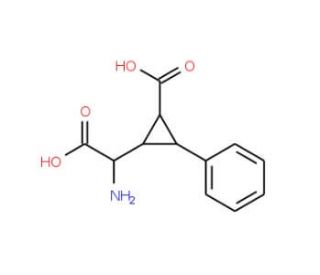

PCCG-4
QUICK LINKS
PCCG-4 is a chemical that functions as a potent inhibitor of a specific enzyme involved in cellular signaling pathways. It exerts its mode of action by binding to the active site of the enzyme, thereby preventing its normal function and disrupting downstream signaling cascades. This disruption ultimately leads to alterations in cellular processes and gene expression. PCCG-4′s mechanism of action involves interfering with the phosphorylation of key proteins, which are for the regulation of various cellular functions. By targeting this specific enzyme, PCCG-4 has the potential to provide insights into the molecular mechanisms underlying certain factors and may contribute to the development of novel research for studying cellular signaling pathways. Its precise mode of action at the molecular level makes it a promising candidate for investigating the role of this enzyme in various biological processes.
PCCG-4 References
- Metabotropic G-protein-coupled glutamate receptors as therapeutic targets. | Pellicciari, R. and Costantino, G. 1999. Curr Opin Chem Biol. 3: 433-40. PMID: 10419848
- Activation of A(1) adenosine or mGlu3 metabotropic glutamate receptors enhances the release of nerve growth factor and S-100beta protein from cultured astrocytes. | Ciccarelli, R., et al. 1999. Glia. 27: 275-81. PMID: 10457374
- Pharmacological agents acting at subtypes of metabotropic glutamate receptors. | Schoepp, DD., et al. 1999. Neuropharmacology. 38: 1431-76. PMID: 10530808
- Design, synthesis and preliminary evaluation of novel 3'-substituted carboxycyclopropylglycines as antagonists at group 2 metabotropic glutamate receptors. | Pellicciari, R., et al. 2001. Bioorg Med Chem Lett. 11: 3179-82. PMID: 11720869
- Evaluation of the enantiomeric selectivity in the chiral ligand-exchange chromatography of amino acids by a computational model. | Natalini, B., et al. 2004. J Chromatogr A. 1033: 363-7. PMID: 15088759
- Synthesis of enantiopure cyclopropyl esters from (-)-levoglucosenone. | Stockton, KP. and Greatrex, BW. 2016. Org Biomol Chem. 14: 7520-8. PMID: 27424764
- Synthesis and pharmacological characterization of all sixteen stereoisomers of 2-(2'-carboxy-3'-phenylcyclopropyl)glycine. Focus on (2S,1'S,2'S,3'R)-2-(2'-carboxy-3'-phenylcyclopropyl)glycine, a novel and selective group II metabotropic glutamate receptors antagonist. | Pellicciari, R., et al. 1996. J Med Chem. 39: 2259-69. PMID: 8667369
- (2S,1'S,2'S,3'R)-2-(2'-carboxy-3'-phenylcyclopropyl)glycine, a potent and selective antagonist of type 2 metabotropic glutamate receptors. | Thomsen, C., et al. 1996. Mol Pharmacol. 50: 6-9. PMID: 8700119
- The neuroprotective activity of group-II metabotropic glutamate receptors requires new protein synthesis and involves a glial-neuronal signaling. | Bruno, V., et al. 1997. J Neurosci. 17: 1891-7. PMID: 9045718
- Type 2 metabotropic glutamate (mGlu) receptors tonically inhibit transmitter release in rat caudate nucleus: in vivo studies with (2S,1'S,2'S,3'R)-2-(2'-carboxy-3'-phenylcyclopropyl)glycine, a new potent and selective antagonist. | Cozzi, A., et al. 1997. Eur J Neurosci. 9: 1350-5. PMID: 9240392
- PCCG-IV inhibits the induction of long-term potentiation in the dentate gyrus in vitro. | Huang, L., et al. 1997. Eur J Pharmacol. 332: 161-5. PMID: 9286617
- Opposite influence of the metabotropic glutamate receptor subtypes mGlu3 and -5 on astrocyte proliferation in culture. | Ciccarelli, R., et al. 1997. Glia. 21: 390-8. PMID: 9419014
- Selective activation of group-II metabotropic glutamate receptors is protective against excitotoxic neuronal death. | Battaglia, G., et al. 1998. Eur J Pharmacol. 356: 271-4. PMID: 9774259
- Roles of metabotropic glutamate receptor subtypes in modulation of pentylenetetrazole-induced seizure activity in mice. | Thomsen, C. and Dalby, NO. 1998. Neuropharmacology. 37: 1465-73. PMID: 9886669
- Asymmetric synthesis of enantiomerically pure (2S,1′S,2′S,3′R)-phenylcarboxycyclopropylglycine (PCCG-4): a potent and selective ligand at group II metabotropic glutamate receptors | Maura Marinozzi a, Benedetto Natalini a, Gabriele Costantino a, Pierre Tijskens a, Christian Thomsen b, Roberto Pellicciari ∗ a. 1996. Bioorganic & Medicinal Chemistry Letters. 6: 2243-2246.
Ordering Information
| Product Name | Catalog # | UNIT | Price | Qty | FAVORITES | |
PCCG-4, 1 mg | sc-222130 | 1 mg | $48.00 | |||
PCCG-4, 5 mg | sc-222130A | 5 mg | $251.00 |