
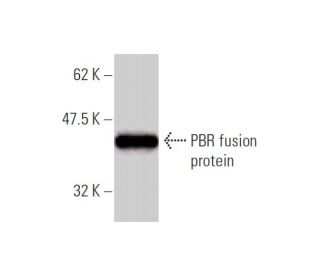

PBR Antibody (3D8-B2): sc-293216
- PBR Antibody (3D8-B2) is a mouse monoclonal IgG1 κ PBR antibody provided at 100 µg/ml
- raised against a full length recombinant protein mapping to amino acids 1-169 of PBR of human origin
- recommended for detection of PBR of human origin by WB, IP and ELISA
- At present, we have not yet completed the identification of the preferred secondary detection reagent(s) for PBR Antibody (3D8-B2). This work is in progress.

QUICK LINKS
SEE ALSO...
PBR Antibody (3D8-B2) is a mouse monoclonal IgG1 kappa light chain antibody that detects the PBR protein of human origin by western blotting (WB), immunoprecipitation (IP), and enzyme-linked immunosorbent assay (ELISA). Anti-PBR antibody (3D8-B2) is available as the non-conjugated form. The peripheral-type benzodiazepine receptor (PBR) plays a crucial role in the steroidogenic process, facilitating the transport of cholesterol into the mitochondria, which is essential for steroid hormone synthesis. PBR is composed of three distinct subunits, including an isoquinoline binding site, a voltage-dependent anion channel, and an adenine nucleotide carrier, highlighting a complex structure vital for function. PBR is evolutionarily conserved across species, from bacteria to humans, and is predominantly expressed in peripheral tissues, with limited presence in the brain, primarily localized in glial cells. Notably, PBR expression can be inhibited by peroxisome proliferator perfluordecanoic acid (PFDA), which affects PBR mRNA stability and subsequently disrupts cholesterol transport and steroidogenesis. PBR interacts with the cytoplasmic protein PRAX-1, which is associated with regulatory functions. The polypeptide diazepam binding inhibitor serves as an endogenous ligand for PBR, while other compounds such as Ro 5-4864 and PK 11185 also bind to this receptor, underscoring significance in cholesterol transport and hormonal regulation.
Alexa Fluor® is a trademark of Molecular Probes Inc., OR., USA
LI-COR® and Odyssey® are registered trademarks of LI-COR Biosciences
PBR Antibody (3D8-B2) References:
- The peroxisome proliferator perfluorodecanoic acid inhibits the peripheral-type benzodiazepine receptor (PBR) expression and hormone-stimulated mitochondrial cholesterol transport and steroid formation in Leydig cells. | Boujrad, N., et al. 2000. Endocrinology. 141: 3137-48. PMID: 10965884
- PK 11195 attenuates kainic acid-induced seizures and alterations in peripheral-type benzodiazepine receptor (PBR) protein components in the rat brain. | Veenman, L., et al. 2002. J Neurochem. 80: 917-27. PMID: 11948256
- PBR, StAR, and PKA: partners in cholesterol transport in steroidogenic cells. | Hauet, T., et al. 2002. Endocr Res. 28: 395-401. PMID: 12530641
- Peripheral-type benzodiazepine receptor (PBR) gene amplification in MDA-MB-231 aggressive breast cancer cells. | Hardwick, M., et al. 2002. Cancer Genet Cytogenet. 139: 48-51. PMID: 12547158
- PAP7, a PBR/PKA-RIalpha-associated protein: a new element in the relay of the hormonal induction of steroidogenesis. | Liu, J., et al. 2003. J Steroid Biochem Mol Biol. 85: 275-83. PMID: 12943713
- Cell surface localization of the peripheral-type benzodiazepine receptor (PBR) in adrenal cortex. | Oke, BO., et al. 1992. Mol Cell Endocrinol. 87: R1-6. PMID: 1332905
- Expression of peripheral benzodiazepine receptor (PBR) in human tumors: relationship to breast, colorectal, and prostate tumor progression. | Han, Z., et al. 2003. J Recept Signal Transduct Res. 23: 225-38. PMID: 14626449
- Peripheral benzodiazepine receptor (PBR) ligand cytotoxicity unrelated to PBR expression. | Hans, G., et al. 2005. Biochem Pharmacol. 69: 819-30. PMID: 15710359
- Peripheral-type benzodiazepine receptor (PBR) aggregation and absence of steroidogenic acute regulatory protein (StAR)/PBR association in the mitochondrial membrane as determined by bioluminescence resonance energy transfer (BRET). | Bogan, RL., et al. 2007. J Steroid Biochem Mol Biol. 104: 61-7. PMID: 17197174
- In vivo studies on the role of the peripheral benzodiazepine receptor (PBR) in steroidogenesis. | Papadopoulos, V., et al. 1998. Endocr Res. 24: 479-87. PMID: 9888528
Ordering Information
| Product Name | Catalog # | UNIT | Price | Qty | FAVORITES | |
PBR Antibody (3D8-B2) | sc-293216 | 100 µg/ml | $322.00 |