
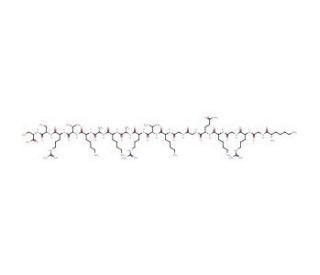

Parasin I (CAS 219552-69-9)
QUICK LINKS
Parasin I is a bioactive peptide originally isolated from the epidermal mucus of the catfish, Parasilurus asotus. This peptide is a part of a broader group of host defense peptides, known for their role in the innate immune system of various organisms. Parasin I has garnered significant interest in scientific research due to its potent antimicrobial properties, particularly against Gram-positive bacteria. The mechanism of action of Parasin I involves disrupting the bacterial cell membrane. The peptide is believed to interact with the lipid components of microbial membranes, inserting itself and causing perturbations that lead to increased membrane permeability and ultimately, cell lysis. This mode of action is typical of many antimicrobial peptides, which compromise bacterial cell integrity rather than targeting specific metabolic pathways. In research contexts, Parasin I has been utilized to study the efficacy and potential of antimicrobial peptides in controlling microbial growth, independent of traditional antibiotic mechanisms. Studies have examined its structure-activity relationships, investigating how alterations in its amino acid sequence affect its antimicrobial potency and spectrum.
Parasin I (CAS 219552-69-9) References
- Cathepsin D produces antimicrobial peptide parasin I from histone H2A in the skin mucosa of fish. | Cho, JH., et al. 2002. FASEB J. 16: 429-31. PMID: 11821259
- Matrix metalloproteinase 2 is involved in the regulation of the antimicrobial peptide parasin I production in catfish skin mucosa. | Cho, JH., et al. 2002. FEBS Lett. 531: 459-63. PMID: 12435593
- Hipposin, a histone-derived antimicrobial peptide in Atlantic halibut (Hippoglossus hippoglossus L.). | Birkemo, GA., et al. 2003. Biochim Biophys Acta. 1646: 207-15. PMID: 12637028
- Identification and structural analysis of the antimicrobial domain in hipposin, a 51-mer antimicrobial peptide isolated from Atlantic halibut. | Birkemo, GA., et al. 2004. Biochim Biophys Acta. 1699: 221-7. PMID: 15158731
- Structure-activity relations of parasin I, a histone H2A-derived antimicrobial peptide. | Koo, YS., et al. 2008. Peptides. 29: 1102-8. PMID: 18406495
- Characterization of bioactive recombinant antimicrobial peptide parasin I fused with human lysozyme expressed in the yeast Pichia pastoris system. | Zhao, H., et al. 2015. Enzyme Microb Technol. 77: 61-7. PMID: 26138401
- Nanoparticle Emulsions Enhance the Inhibition of NLRP3. | Cao, M. and Cai, L. 2022. Int J Mol Sci. 23: PMID: 36077562
- Pickering emulsion stabilized by parasin I and chitosan nanoparticles enhances protection against intestinal microbiota homeostasis by reducing inflammation in peritonitis mice. | Cao, M., et al. 2023. Int J Biol Macromol. 242: 125016. PMID: 37263085
- Compound bioengineering protein supplementation improves intestinal health and growth performance of broilers. | Tang, YT., et al. 2023. Poult Sci. 102: 103037. PMID: 37657250
- Parasin I, an antimicrobial peptide derived from histone H2A in the catfish, Parasilurus asotus. | Park, IY., et al. 1998. FEBS Lett. 437: 258-62. PMID: 9824303
Ordering Information
| Product Name | Catalog # | UNIT | Price | Qty | FAVORITES | |
Parasin I, 0.5 mg | sc-397037 | 0.5 mg | $190.00 |