
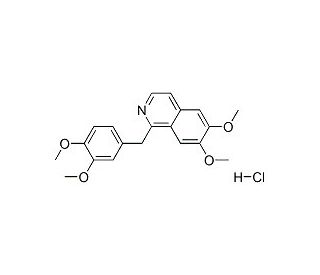

Papaverine hydrochloride (CAS 61-25-6)
See product citations (4)
QUICK LINKS
Papaverine hydrochloride is a chemical that functions as a smooth muscle relaxant. It exerts its mode of action by inhibiting the enzyme phosphodiesterase, leading to an increase in intracellular levels of cyclic adenosine monophosphate (cAMP). This increase in cAMP levels results in the relaxation of smooth muscle cells, particularly those found in the blood vessels. By causing vasodilation, papaverine hydrochloride can increase blood flow to certain tissues and organs. Papaverine hydrochloride′s mode of action involves its ability to directly affect the contractility of smooth muscle cells, leading to a reduction in muscle tone and relaxation of the muscle fibers. In experimental applications, papaverine hydrochloride is used to study the effects of smooth muscle relaxation and vasodilation on various physiological processes.
Papaverine hydrochloride (CAS 61-25-6) References
- Dynamic response of the intracranial system in the conscious dog to papaverine hydrochloride. | Schettini, A. and Furniss, WW. 1976. Stroke. 7: 618-25. PMID: 1006739
- Papaverine induces apoptosis in vascular endothelial and smooth muscle cells. | Gao, YJ., et al. 2002. Life Sci. 70: 2675-85. PMID: 12269394
- Papaverine hydrochloride in thiobarbiturate anesthesia in dogs. | GRUBER, CM., et al. 1953. Arch Int Pharmacodyn Ther. 93: 248-54. PMID: 13058511
- Kinetics of photooxidation of papaverine hydrochloride and its major photooxidation products. | Piotrowska, K., et al. 2006. J Pharm Biomed Anal. 41: 1391-5. PMID: 16580169
- The effect of papaverine on ion channels in rat basilar smooth muscle cells. | Han, DH., et al. 2007. Neurol Res. 29: 544-50. PMID: 17535590
- Cytotoxicity induced by papaverine hydrochloride in fungal cell systems. | Davila, JC., et al. 1990. Toxicol Lett. 54: 23-31. PMID: 2244336
- Toxicity assessment of papaverine hydrochloride and papaverine-derived metabolites in primary cultures of rat hepatocytes. | Davila, JC., et al. 1990. In Vitro Cell Dev Biol. 26: 515-24. PMID: 2351644
- Comparison of the anti-respiratory syncytial virus activity and toxicity of papaverine hydrochloride and pyrazofurin in vitro and in vivo. | Wyde, PR., et al. 1989. Antiviral Res. 11: 15-26. PMID: 2653219
- PHARMACOKINETICS OF DICLOFENAC SODIUM AND PAPAVERINE HYDROCHLORIDE AFTER ORAL ADMINISTRATION OF TABLETS TO RABBITS. | Kasperek, R., et al. 2015. Acta Pol Pharm. 72: 527-38. PMID: 26642661
- Papaverine-induced inhibition of phosphodiesterase activity in various mammalian tissues. | Pöch, G. and Kukovetz, WR. 1971. Life Sci I. 10: 133-44. PMID: 4325052
- Effects of papaverine on smooth muscle and their mechanisms. | Ferrari, M. 1974. Pharmacol Res Commun. 6: 97-115. PMID: 4373766
- Effect of purine derivatives, papaverine hydrochloride, and imidazole on enterotoxin formation by Clostridium perfringens type A. | Craven, SE. and Blankenship, LC. 1982. Can J Microbiol. 28: 851-9. PMID: 6184146
- Papaverine hydrochloride: effects on HIV replication and T-lymphocyte cell function. | Nokta, M., et al. 1993. Immunopharmacology. 26: 181-5. PMID: 7506701
Ordering Information
| Product Name | Catalog # | UNIT | Price | Qty | FAVORITES | |
Papaverine hydrochloride, 5 g | sc-202273 | 5 g | $52.00 |