
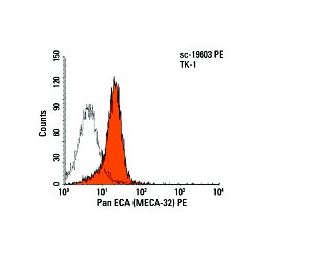

pan ECA Antibody (MECA-32): sc-19603
- pan ECA Antibody (MECA-32) is a rat monoclonal IgG2a pan ECA antibody, cited in 17 publications, provided at 200 µg/ml
- raised against mouse lymph node stromal cells
- pan ECA Antibody (MECA-32) is recommended for detection of a dimer of subunits expressed on endothelial cells in embryonic and adult mouse, with the exception of cardicac muscle, skeletal muscle and brain of mouse origin by IP, IF and FCM
- Anti-pan ECA Antibody (MECA-32) is available conjugated to agarose for IP; HRP for WB, IHC(P) and ELISA; and to either phycoerythrin or FITC for IF, IHC(P) and FCM
- also available conjugated to Alexa Fluor® 488, Alexa Fluor® 546, Alexa Fluor® 594 or Alexa Fluor® 647 for WB (RGB), IF, IHC(P) and FCM, and for use with RGB fluorescent imaging systems, such as iBright™ FL1000, FluorChem™, Typhoon, Azure and other comparable systems
- also available conjugated to Alexa Fluor® 680 or Alexa Fluor® 790 for WB (NIR), IF and FCM; for use with Near-Infrared (NIR) detection systems, such as LI-COR®Odyssey®, iBright™ FL1000, FluorChem™, Typhoon, Azure and other comparable systems
- At present, we have not yet completed the identification of the preferred secondary detection reagent(s) for pan ECA Antibody (MECA-32). This work is in progress.

QUICK LINKS
SEE ALSO...
pan ECA Antibody (MECA-32) is a rat monoclonal IgG2a antibody that detects pan ECA proteins of mouse origin by immunoprecipitation (IP), immunofluorescence (IF), and flow cytometry (FCM). Anti-pan ECA antibody (MECA-32) is available in both non-conjugated and various conjugated forms, including agarose, horseradish peroxidase (HRP), phycoerythrin (PE), fluorescein isothiocyanate (FITC), and multiple Alexa Fluor® conjugates. pan ECA proteins play a crucial role in the formation and maintenance of the vascular network, which is essential for proper blood circulation and nutrient delivery throughout the body. These proteins are primarily located on the surface of endothelial cells, which line blood vessels and are vital for regulating vascular permeability and inflammation. pan ECA protein expression is particularly significant during embryonic development, as these proteins facilitate the formation of new blood vessels through a process known as angiogenesis. pan ECA (MECA-32) antibody exhibits high specificity for mouse endothelium in both embryonic and mature tissues, marking pan ECA (MECA-32) monoclonal antibody as a valuable tool for studying vascular biology. Notably, MECA-32 antigen is expressed on most endothelial cells in the embryonic and adult mouse, with the exception of certain tissues such as the brain, skeletal muscle, and cardiac muscle, where expression is selectively regulated. In the brain, MECA-32 presence is inversely related to the maturation of the blood-brain barrier, highlighting MECA-32′s importance in vascular differentiation and function.
Alexa Fluor® is a trademark of Molecular Probes Inc., OR., USA
LI-COR® and Odyssey® are registered trademarks of LI-COR Biosciences
pan ECA Antibody (MECA-32) References:
- Aging and innate immune cells. | Plackett, TP., et al. 2004. J Leukoc Biol. 76: 291-9. PMID: 15039467
- Chemokine receptors and leukocyte trafficking in the mucosal immune system. | Williams, IR. 2004. Immunol Res. 29: 283-92. PMID: 15181289
- In vivo imaging of leukocyte trafficking in blood vessels and tissues. | Mempel, TR., et al. 2004. Curr Opin Immunol. 16: 406-17. PMID: 15245733
- Interactions between the innate immune and blood coagulation systems. | Esmon, CT. 2004. Trends Immunol. 25: 536-42. PMID: 15364056
- Chemokines: control of primary and memory T-cell traffic. | Schaerli, P. and Moser, B. 2005. Immunol Res. 31: 57-74. PMID: 15591623
- Immune traffic: a functional overview. | Beilhack, A. and Rockson, SG. 2003. Lymphat Res Biol. 1: 219-34. PMID: 15624439
- Leukocyte adhesion: what's the catch? | Hammer, DA. 2005. Curr Biol. 15: R96-9. PMID: 15694300
- Diabetes mellitus induces bone marrow microangiopathy. | Oikawa, A., et al. 2010. Arterioscler Thromb Vasc Biol. 30: 498-508. PMID: 20042708
- Hypoxia-induced vascular remodeling responses in the brain are much more robust than other organs. | Sapkota, A., et al. 2023. Microvasc Res. 148: 104517. PMID: 36894025
- Structural insights into plasmalemma vesicle-associated protein (PLVAP): Implications for vascular endothelial diaphragms and fenestrae. | Chang, TH., et al. 2023. Proc Natl Acad Sci U S A. 120: e2221103120. PMID: 36996108
- Biology of red cells: non-nucleated erythrocytes as fluid drop-like cell fragments. | Schmid-Schönbein, H., et al. 1984. Int J Microcirc Clin Exp. 3: 161-96. PMID: 6386726
- Novel mouse endothelial cell surface marker is suppressed during differentiation of the blood brain barrier. | Hallmann, R., et al. 1995. Dev Dyn. 202: 325-32. PMID: 7626790
Ordering Information
| Product Name | Catalog # | UNIT | Price | Qty | FAVORITES | |
pan ECA Antibody (MECA-32) | sc-19603 | 200 µg/ml | $322.00 | |||
pan ECA Antibody (MECA-32) AC | sc-19603 AC | 500 µg/ml, 25% agarose | $424.00 | |||
pan ECA Antibody (MECA-32) HRP | sc-19603 HRP | 200 µg/ml | $322.00 | |||
pan ECA Antibody (MECA-32) FITC | sc-19603 FITC | 200 µg/ml | $336.00 | |||
pan ECA Antibody (MECA-32) PE | sc-19603 PE | 200 µg/ml | $349.00 | |||
pan ECA Antibody (MECA-32) Alexa Fluor® 488 | sc-19603 AF488 | 200 µg/ml | $364.00 | |||
pan ECA Antibody (MECA-32) Alexa Fluor® 546 | sc-19603 AF546 | 200 µg/ml | $364.00 | |||
pan ECA Antibody (MECA-32) Alexa Fluor® 594 | sc-19603 AF594 | 200 µg/ml | $364.00 | |||
pan ECA Antibody (MECA-32) Alexa Fluor® 647 | sc-19603 AF647 | 200 µg/ml | $364.00 | |||
pan ECA Antibody (MECA-32) Alexa Fluor® 680 | sc-19603 AF680 | 200 µg/ml | $364.00 | |||
pan ECA Antibody (MECA-32) Alexa Fluor® 790 | sc-19603 AF790 | 200 µg/ml | $364.00 |