
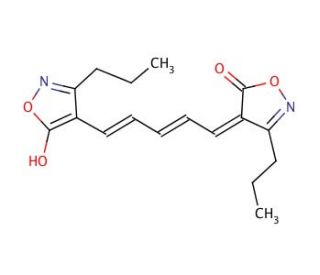

Structure moléculaire de Oxonol VI, Numéro CAS: 64724-75-0
Oxonol VI (CAS 64724-75-0)
Application(s):
Oxonol VI est un indicateur optique des potentiels membranaires
Numéro CAS:
64724-75-0
Masse Moléculaire:
316.35
Formule Moléculaire:
C17H20N2O4
Pour la Recherche Uniquement. Non conforme pour le Diagnostic ou pour une Utilisation Thérapeutique.
* Consulter le Certificat d'Analyses pour les données spécifiques à un lot (incluant la teneur en eau).
ACCÈS RAPIDE AUX LIENS
Informations pour la commande
Description
Information Technique
Données de Sécurité
SDS & Certificat d’Analyses
Oxonol VI s'engage avec les protéines, les acides nucléiques et divers composants cellulaires en employant le mécanisme de transfert d'électrons photo-induit (TEP). Au cours de ce mécanisme, le colorant absorbe l'énergie lumineuse, ce qui conduit à son excitation. Ensuite, le colorant excité transfère l'énergie à la molécule cible, ce qui déclenche son excitation et l'émission de lumière. Cette procédure permet aux chercheurs d'examiner la structure et la fonctionnalité des protéines, des acides nucléiques et d'autres composants cellulaires.
Oxonol VI (CAS 64724-75-0) Références
- Mesures ratiométriques de fluorescence du potentiel membranaire généré par la H(+)-ATPase de la membrane plasmique de la levure reconstituée en vésicules. | Holoubek, A., et al. 2003. Biochim Biophys Acta. 1609: 71-9. PMID: 12507760
- Interaction entre les liposomes DMPC et le polymère HM-PNIPAM. | Wang, Yj., et al. 2003. Biophys Chem. 104: 449-58. PMID: 12878312
- Na+-pyrophosphatase: une nouvelle pompe à sodium primaire. | Malinen, AM., et al. 2007. Biochemistry. 46: 8872-8. PMID: 17605473
- Cinétique de la sonde extrinsèque sensible au potentiel, l'oxonol VI, dans les particules submitochondriales du coeur de boeuf. | Smith, JC. and Chance, B. 1979. J Membr Biol. 46: 255-82. PMID: 233819
- L'oxonol VI comme indicateur optique des potentiels membranaires dans les vésicules lipidiques. | Apell, HJ. and Bersch, B. 1987. Biochim Biophys Acta. 903: 480-94. PMID: 2444259
- Étude cinétique en flux arrêté de l'interaction de colorants oxonol sensibles au potentiel avec des vésicules lipidiques. | Clarke, RJ. and Apell, HJ. 1989. Biophys Chem. 34: 225-37. PMID: 2611347
- Mesure du pompage de H(+) et de la formation du potentiel membranaire dans les systèmes de vésicules à membrane scellée. | Wielandt, AG., et al. 2016. Methods Mol Biol. 1377: 171-80. PMID: 26695032
- Caractérisation fonctionnelle du canal Kv1.3 exprimé à l'état libre à l'aide d'un colorant fluorescent sensible à la tension. | Cortes, S., et al. 2018. Protein Expr Purif. 145: 94-99. PMID: 29366963
- Dépolarisation des cellules granuleuses cérébelleuses de rat induite par le tétrabromobisphénol A: études ex vivo et in vitro. | Diamandakis, D., et al. 2019. Chemosphere. 223: 64-73. PMID: 30769291
- Utilisation de caroténoïdes et d'oxonol VI comme sondes du potentiel membranaire dans les protéoliposomes. | van Walraven, HS., et al. 1985. FEBS Lett. 184: 96-9. PMID: 3157600
- Les pompes ATPases transmembranaires Cu(I) de type P sont des uniporters électrogéniques. | Abeyrathna, N., et al. 2020. Dalton Trans. 49: 16082-16094. PMID: 32469032
- Électrogénèse dans la fraction de membrane plasmique de la microalgue halotolérante Dunaliella maritima et effets du N,N'-Dicyclohexylcarbodiimide. | Popova, LG., et al. 2020. Biochemistry (Mosc). 85: 930-937. PMID: 33045953
- Effets du Cd2+ sur le potentiel de membrane induit par l'ATP dans la H+-ATPase mitochondriale du cœur de bœuf: une étude utilisant la sonde sensible au voltage oxonol VI. | Pringle, MJ. and Sanadi, DR. 1984. Membr Biochem. 5: 225-41. PMID: 6235431
- Réponse spectrale dépendante de l'ATP de l'oxonol VI dans un complexe d'échange ATP-Pi. | Kiehl, R. and Hanstein, WG. 1984. Biochim Biophys Acta. 766: 375-85. PMID: 6235853
Informations pour la commande
| Nom du produit | Ref. Catalogue | COND. | Prix HT | QTÉ | Favoris | |
Oxonol VI, 100 mg | sc-212489 | 100 mg | $415.00 |