
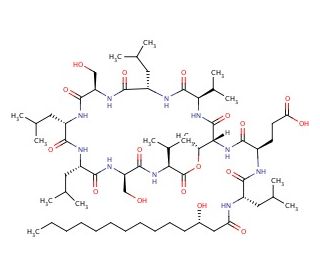

Orfamide B (CAS 939960-35-7)
See product citations (2)
QUICK LINKS
Orfamide B is a cyclic lipopeptide closely related to orfamide A, produced by Pseudomonas protegens, a bacterium known for its role in agricultural biocontrol and plant health enhancement. Like its counterpart, orfamide B is comprised of a cyclic peptide linked to a hydrophobic fatty acid chain, which facilitates its insertion and disruption of fungal cell membranes. This amphiphilic nature allows orfamide B to effectively permeate and compromise the integrity of fungal membranes, thereby inhibiting the growth of plant pathogens and supporting plant defense mechanisms. The chemical′s action is primarily fungicidal, targeting the membrane structure and leading to cellular contents leakage and cell death in fungal pathogens. In research, orfamide B has been utilized to explore ecological interactions between beneficial bacteria and plant pathogens, helping explain the mechanisms by which microbial products can suppress disease and promote plant health. Studies on orfamide B include investigations into its biosynthetic pathways, regulatory networks influencing its production, and its potential synergistic effects with other bioactive compounds produced by Pseudomonas spp. This research enhances our understanding of natural biocontrol agents and supports the development of integrated pest management strategies that leverage microbial metabolites to reduce reliance on chemical pesticides in agriculture.
Orfamide B (CAS 939960-35-7) References
- Interplay between orfamides, sessilins and phenazines in the control of Rhizoctonia diseases by Pseudomonas sp. CMR12a. | Olorunleke, FE., et al. 2015. Environ Microbiol Rep. 7: 774-81. PMID: 26085277
- Biosynthesis, Chemical Structure, and Structure-Activity Relationship of Orfamide Lipopeptides Produced by Pseudomonas protegens and Related Species. | Ma, Z., et al. 2016. Front Microbiol. 7: 382. PMID: 27065956
- Antagonistic bacteria disrupt calcium homeostasis and immobilize algal cells. | Aiyar, P., et al. 2017. Nat Commun. 8: 1756. PMID: 29170415
- Characterization of a Versatile Plant Growth-Promoting Rhizobacterium Pseudomonas mediterranea Strain S58. | Gu, Y., et al. 2020. Microorganisms. 8: PMID: 32120878
- Pseudomonas Lipopeptide-Mediated Biocontrol: Chemotaxonomy and Biological Activity. | Oni, FE., et al. 2022. Molecules. 27: PMID: 35056688
- Combining in vitro and in vivo screening to identify efficient Pseudomonas biocontrol strains against the phytopathogenic bacterium Ralstonia solanacearum. | Clough, SE., et al. 2022. Microbiologyopen. 11: e1283. PMID: 35478286
- An Nuclear Magnetic Resonance Fingerprint Matching Approach for the Identification and Structural Re-Evaluation of Pseudomonas Lipopeptides. | De Roo, V., et al. 2022. Microbiol Spectr. 10: e0126122. PMID: 35876524
- New Pseudomonas Bacterial Strains: Biological Activity and Characteristic Properties of Metabolites. | Sidorova, TM., et al. 2023. Microorganisms. 11: PMID: 37630503
- Stereomeric Lipopeptides from a Single Non-Ribosomal Peptide Synthetase as an Additional Source of Structural and Functional Diversification in Pseudomonas Lipopeptide Biosynthesis. | Muangkaew, P., et al. 2023. Int J Mol Sci. 24: PMID: 37762605
- The genome of a steinernematid-associated Pseudomonas piscis bacterium encodes the biosynthesis of insect toxins. | Awori, RM., et al. 2023. Access Microbiol. 5: PMID: 37970093
Ordering Information
| Product Name | Catalog # | UNIT | Price | Qty | FAVORITES | |
Orfamide B, 1 mg | sc-391683 | 1 mg | $280.00 | |||
Orfamide B, 5 mg | sc-391683A | 5 mg | $781.00 |