
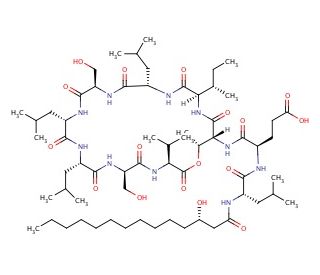

Molecular structure of Orfamide A, CAS Number: 939960-34-6
Orfamide A (CAS 939960-34-6)
See product citations (4)
Application:
Orfamide A is a possible antifungal agent
CAS Number:
939960-34-6
Molecular Weight:
1295.64
Molecular Formula:
C64H114N10O17
For Research Use Only. Not Intended for Diagnostic or Therapeutic Use.
* Refer to Certificate of Analysis for lot specific data.
QUICK LINKS
Ordering Information
Product Citations
Description
Technical Information
Safety Information
SDS & Certificate of Analysis
Orfamide A is the major component of a family of cyclic lipopeptides. It appears to be a selective antifungal agent and an inhibitor of the enzyme acetylcholinesterase. It has been studied due to its anti-inflammatory, anti-bacterial, and anti-cancer properties. Additionally, it has been employed to study the effects of Orfamide A inhibitors on cognitive function and memory.
Orfamide A (CAS 939960-34-6) References
- Heavy tools for genome mining. | Corre, C. and Challis, GL. 2007. Chem Biol. 14: 7-9. PMID: 17254946
- The genomisotopic approach: a systematic method to isolate products of orphan biosynthetic gene clusters. | Gross, H., et al. 2007. Chem Biol. 14: 53-63. PMID: 17254952
- The effect of iron limitation on the transcriptome and proteome of Pseudomonas fluorescens Pf-5. | Lim, CK., et al. 2012. PLoS One. 7: e39139. PMID: 22723948
- Identification of orfamide A as an insecticidal metabolite produced by Pseudomonas protegens F6. | Jang, JY., et al. 2013. J Agric Food Chem. 61: 6786-91. PMID: 23763636
- An Interspecies Signaling System Mediated by Fusaric Acid Has Parallel Effects on Antifungal Metabolite Production by Pseudomonas protegens Strain Pf-5 and Antibiosis of Fusarium spp. | Quecine, MC., et al. 2015. Appl Environ Microbiol. 82: 1372-1382. PMID: 26655755
- Living on the edge: emergence of spontaneous gac mutations in Pseudomonas protegens during swarming motility. | Song, C., et al. 2016. Environ Microbiol. 18: 3453-3465. PMID: 26945503
- Rhizoxin analogs, orfamide A and chitinase production contribute to the toxicity of Pseudomonas protegens strain Pf-5 to Drosophila melanogaster. | Loper, JE., et al. 2016. Environ Microbiol. 18: 3509-3521. PMID: 27130686
- The cyclic lipopeptide orfamide induces systemic resistance in rice to Cochliobolus miyabeanus but not to Magnaporthe oryzae. | Ma, Z., et al. 2017. Plant Cell Rep. 36: 1731-1746. PMID: 28801742
- Antagonistic bacteria disrupt calcium homeostasis and immobilize algal cells. | Aiyar, P., et al. 2017. Nat Commun. 8: 1756. PMID: 29170415
- The bacterium Pseudomonas protegens antagonizes the microalga Chlamydomonas reinhardtii using a blend of toxins. | Rose, MM., et al. 2021. Environ Microbiol. 23: 5525-5540. PMID: 34347373
- A polyyne toxin produced by an antagonistic bacterium blinds and lyses a Chlamydomonad alga. | Hotter, V., et al. 2021. Proc Natl Acad Sci U S A. 118: PMID: 34389682
- Total Synthesis and Structure Correction of the Cyclic Lipodepsipeptide Orfamide A. | Bando, Y., et al. 2022. Chemistry. 28: e202104417. PMID: 35199896
- Combining in vitro and in vivo screening to identify efficient Pseudomonas biocontrol strains against the phytopathogenic bacterium Ralstonia solanacearum. | Clough, SE., et al. 2022. Microbiologyopen. 11: e1283. PMID: 35478286
- The Role of Pyoluteorin from Pseudomonas protegens Pf-5 in Suppressing the Growth and Pathogenicity of Pantoea ananatis on Maize. | Gu, Q., et al. 2022. Int J Mol Sci. 23: PMID: 35742879
- A cyclic lipopeptide produced by an antagonistic bacterium relies on its tail and transient receptor potential-type Ca2+ channels to immobilize a green alga. | Hou, Y., et al. 2023. New Phytol. 237: 1620-1635. PMID: 36464797
Ordering Information
| Product Name | Catalog # | UNIT | Price | Qty | FAVORITES | |
Orfamide A, 1 mg | sc-391534 | 1 mg | $310.00 | |||
Orfamide A, 5 mg | sc-391534A | 5 mg | $900.00 |