
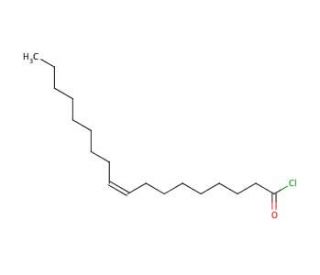

Oleoyl chloride (CAS 112-77-6)
See product citations (2)
QUICK LINKS
Oleoyl chloride, also referred to as oleic acid chloride, is a chemical compound derived from fatty acids. It plays a significant role as an intermediate in organic synthesis and finds wide-ranging applications. Moreover, oleoyl chloride is employed in the production of various lipid-based compounds, including surfactants and emulsifiers. Beyond its role in organic synthesis, oleoyl chloride also contributes to the manufacturing of polymers and coatings. Although the complete mechanism of action of oleoyl chloride remains elusive, it is believed that the reaction between oleic acid and thionyl chloride leads to the formation of oleoyl chloride and hydrogen chloride. Subsequently, hydrogen chloride reacts with oleoyl chloride acid, resulting in the generation of oleoyl chloride.
Oleoyl chloride (CAS 112-77-6) References
- Hydrogels formed by crosslinked poly(vinyl alcohol) as sustained drug delivery systems. | Orienti, I., et al. 2002. Arch Pharm (Weinheim). 335: 89-93. PMID: 12043460
- Chemical modification of jute fibers for the production of green-composites. | Corrales, F., et al. 2007. J Hazard Mater. 144: 730-5. PMID: 17320283
- Effect of the molecular mass and degree of substitution of oleoylchitosan on the structure, rheological properties, and formation of nanoparticles. | Li, YY., et al. 2007. J Agric Food Chem. 55: 4842-7. PMID: 17497792
- Modification of lysozyme with oleoyl chloride for broadening the antimicrobial specificity. | Evran, S., et al. 2010. Prep Biochem Biotechnol. 40: 316-25. PMID: 21108135
- Preparation and characterization of nanoparticles based on hydrophobic alginate derivative as carriers for sustained release of vitamin D3. | Li, Q., et al. 2011. J Agric Food Chem. 59: 1962-7. PMID: 21288023
- Rapid esterification of wheat straw hemicelluloses induced by microwave irradiation. | Xu, F., et al. 2008. Carbohydr Polym. 73: 612-20. PMID: 26048228
- Total synthesis of a cyclopropane-fatty acid α-glucosyl diglyceride from Lactobacillus plantarum and identification of its ability to signal through Mincle. | Shah, S., et al. 2016. Chem Commun (Camb). 52: 10902-5. PMID: 27533919
- Quantitative measurement of sn-1,2-diacylglycerols present in platelets, hepatocytes, and ras- and sis-transformed normal rat kidney cells. | Preiss, J., et al. 1986. J Biol Chem. 261: 8597-600. PMID: 3013856
- Silibinin encapsulation in polymersome: A promising anticancer nanoparticle for inducing apoptosis and decreasing the expression level of miR-125b/miR-182 in human breast cancer cells. | Hossainzadeh, S., et al. 2019. J Cell Physiol. 234: 22285-22298. PMID: 31073992
- Highly efficient synthesis of 4,4-dimethylsterol oleates using acyl chloride method through esterification. | Xie, L., et al. 2021. Food Chem. 364: 130140. PMID: 34175623
- Unravelling the Hydration Barrier of Lignin Oleate Nanoparticles for Acid- and Base-Catalyzed Functionalization in Dispersion State. | Moreno, A., et al. 2021. Angew Chem Int Ed Engl. 60: 20897-20905. PMID: 34196470
- Effect of the Micronization of Pulp Fibers on the Properties of Green Composites. | Valente, BFA., et al. 2021. Molecules. 26: PMID: 34577065
- Protein/amphipathic polyamine complexes enable highly efficient transfection with minimal toxicity. | Budker, V., et al. 1997. Biotechniques. 23: 139, 142-7. PMID: 9232246
Ordering Information
| Product Name | Catalog # | UNIT | Price | Qty | FAVORITES | |
Oleoyl chloride, 250 mg | sc-215625 | 250 mg | $102.00 |