
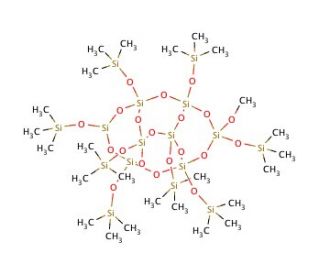

Octakis(trimethylsiloxy)silsesquioxane (CAS 51777-38-9)
QUICK LINKS
Octakis(trimethylsiloxy)silsesquioxane, a polysiloxane, has garnered significant attention for its distinctive properties and potential applications. Presenting as a white crystalline powder, this compound is insoluble in water. Comprising eight trimethylsiloxy groups, it is a low-molecular-weight organosilicon compound synthesized through the reaction of trimethylchlorosilane and octamethylcyclotetrasiloxane. Scientific research has extensively explored the unique properties and potential applications of Octakis(trimethylsiloxy)silsesquioxane. It has proven useful as an anti-fouling agent in marine coatings and a lubricant in medical devices. Furthermore, it serves as a precursor for synthesizing various polysiloxanes and silsesquioxanes. Additionally, this compound enhances the physical properties of polymers, including increased hydrophobicity, thermal stability, and mechanical strength. While the exact mechanism of action of Octakis(trimethylsiloxy)silsesquioxane remains elusive, it is postulated that the compound interacts with the surface of the material it contacts. The trimethylsiloxy groups are believed to form a protective layer on the surface, preventing fouling or contamination. Moreover, the silsesquioxane structure is thought to create a low-friction environment, reducing friction between the material and the surface.
Octakis(trimethylsiloxy)silsesquioxane (CAS 51777-38-9) References
- Trapping of atomic hydrogens in cage-shaped silsesquioxanes by electric discharge. | Harima, Y., et al. 2010. Chem Commun (Camb). 46: 2076-8. PMID: 20221497
- Functionalization of silica surfaces with mixtures of 3-aminopropyl and methyl groups | Marco Luechinger, Roel Prins, Gerhard D. Pirngruber. 2005. Microporous and Mesoporous Materials. 85: 111-118.
- Effect of framework Si/Al ratio and extra-framework aluminum on the catalytic activity of Y zeolite | Bin Xu a, Silvia Bordiga b, Roel Prins a, Jeroen A. van Bokhoven a. 2007. Applied Catalysis A: General. 333: 245-253.
- Hierarchical SAPO-5 catalysts active in acid-catalyzed reactions | Nadiya Danilina a, Frank Krumeich b, Jeroen A. van Bokhoven a. 2010. Journal of Catalysis. 272: 37-43.
- Enhancement of catalytic performance in the benzylation of benzene with benzyl alcohol over hierarchical mordenite | Kunyue Leng a, Yi Wang a c, Changmin Hou b, Christine Lancelot c, Carole Lamonier c, Alain Rives c, Yinyong Sun a. 2013. Journal of Catalysis. 306: 100-108.
- Alkylphosphonic acid- and small amine-templated synthesis of hierarchical silicoaluminophosphate molecular sieves with high isomerization selectivity to di-branched paraffins | Yu Fan a b, Han Xiao b, Gang Shi b, Haiyan Liu b, Xiaojun Bao a b. 2015. Journal of Catalysis. 285: 251-259.
- Five- and six-fold coordinated silicon in silicodiphosphonates: short range order investigation by solid-state NMR spectroscopy | Christine Viehweger,a Janine Kowalke,b Erica Brendler, *a Sandra Schwarzer,c Claudia Vogt b and Edwin Kroke *b . 2020. New J. Chem. 44: 4613-4620.
Ordering Information
| Product Name | Catalog # | UNIT | Price | Qty | FAVORITES | |
Octakis(trimethylsiloxy)silsesquioxane, 1 g | sc-301503 | 1 g | $72.00 | |||
Octakis(trimethylsiloxy)silsesquioxane, 5 g | sc-301503A | 5 g | $218.00 |