
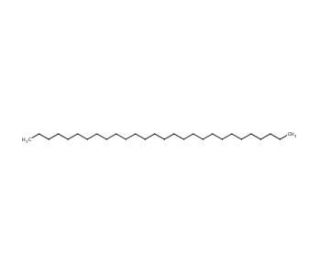

Octacosane (CAS 630-02-4)
See product citations (1)
QUICK LINKS
Octacosane, or octacosanol, is a naturally occurring long-chain saturated fatty alcohol present in the wax of various plants like wheat germ, rice bran, and sugar cane. At room temperature, it takes the form of a colorless, odorless, waxy solid and has a melting point of approximately 50°C. Although the exact mechanism of action of octacosane remains somewhat unclear, there is a belief that it functions as an antioxidant by neutralizing reactive oxygen species and thereby reducing oxidative damage. Furthermore, it is thought to reduce cholesterol levels by impeding cholesterol synthesis in the liver. Lastly, it is believed to enhance physical performance by optimizing energy production efficiency within the body.
Octacosane (CAS 630-02-4) References
- Molecular dynamics simulation of octacosane for phase diagrams and properties via the united-atom scheme. | Dai, L., et al. 2021. Phys Chem Chem Phys. 23: 21262-21271. PMID: 34543374
- Molecular simulation of linear octacosane via a CG10 coarse grain scheme. | Dai, L., et al. 2022. Phys Chem Chem Phys. 24: 5351-5359. PMID: 35169819
- Comparative transcriptome analysis reveals different adaptation mechanisms for degradation of very long-chain and normal long-chain alkanes in Dietzia sp. DQ12-45-1b. | Xu, HX., et al. 2022. Environ Microbiol. 24: 1932-1945. PMID: 35191184
- Plant volatile organic compounds attractive to Lygus pratensis. | Feng, H., et al. 2022. Open Life Sci. 17: 362-371. PMID: 35586846
- In vivo antihyperglycaemic and antihyperlipidemic activities and chemical constituents of Solanum anomalum. | Okokon, JE., et al. 2022. Biomed Pharmacother. 151: 113153. PMID: 35598372
- Aroma Profile and Biological Effects of Ochradenus arabicus Essential Oils: A Comparative Study of Stem, Flowers, and Leaves. | Ullah, O., et al. 2022. Molecules. 27: PMID: 36014440
- Extracts from Cabbage Leaves: Preliminary Results towards a 'Universal' Highly-Performant Antibacterial and Antifungal Natural Mixture. | Arrais, A., et al. 2022. Biology (Basel). 11: PMID: 36101458
- Spectral Analysis and Antiulcer Potential of Lactuca sativa through the Amelioration of Proinflammatory Cytokines and Apoptosis Markers. | Syed, RU., et al. 2022. Life (Basel). 12: PMID: 36295076
- Genome Sequence of the Euphotic Hawaiian Gammaproteobacterium HetDA_MAG_MS8, in the Order Nevskiales, Family Oceanococcaceae, Genus Oceanococcus. | Mahdavi, KA., et al. 2023. Microbiol Resour Announc. 12: e0059222. PMID: 36515538
- Antioxidant, Wound Healing Potential and In Silico Assessment of Naringin, Eicosane and Octacosane. | Balachandran, A., et al. 2023. Molecules. 28: PMID: 36770709
- Antibacterial properties and GC-MS analysis of ethyl acetate extracts of Xerophyta spekei (Baker) and Grewia tembensis (Fresen). | Nyalo, PO., et al. 2023. Heliyon. 9: e14461. PMID: 36925541
- Farm or Lab? A Comparative Study of Oregano's Leaf and Callus Volatile Isolates Chemistry and Cytotoxicity. | Kakalis, A., et al. 2023. Plants (Basel). 12: PMID: 37050098
- Impact of Salting Techniques on the Physio-Chemical Characteristics, Sensory Properties, and Volatile Organic Compounds of Ras Cheese. | Amer, DA., et al. 2023. Foods. 12: PMID: 37174391
- Green Synthesis of Zinc Oxide Nanoparticles Using Viscum album Extracts: Unveiling Bioactive Compounds, Antibacterial Potential, and Antioxidant Activities. | Mushtaq, W., et al. 2023. Plants (Basel). 12: PMID: 37299109
Ordering Information
| Product Name | Catalog # | UNIT | Price | Qty | FAVORITES | |
Octacosane, 1 g | sc-257940 | 1 g | $25.00 |