
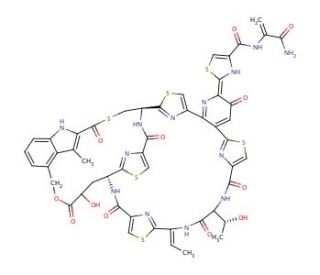

Nosiheptide (CAS 56377-79-8)
LINKS RÁPIDOS
O nosiheptídeo, também conhecido como multiomicina, é um tiopeptídeo produzido pela bactéria Streptomyces actuosus. Tem sido amplamente estudado pela sua capacidade de atingir a subunidade 50S dos ribossomas bacterianos, ligando-se especificamente ao 23S rRNA perto do centro da peptidil transferase. Esta interação perturba eficazmente a função ribossómica, inibindo a formação de ligações peptídicas entre aminoácidos durante a síntese proteica. Este mecanismo fez do nosiheptídeo uma ferramenta essencial para os investigadores que exploram a síntese proteica bacteriana e a estrutura dos ribossomas. Fornece uma sonda molecular para explicar os meandros da inibição da tradução e da dinâmica dos ribossomas. Os estudos estruturais, que utilizam técnicas avançadas como a cristalografia de raios X e a microscopia crioelectrónica, beneficiaram da utilização do nosiheptídeo para compreender melhor as interacções e a estabilidade dos ribossomas. Além disso, o impacto do nosiheptídeo estende-se ao domínio da engenharia ribossómica e da biologia sintética. Os conhecimentos adquiridos a partir da sua interação com o ribossoma são aproveitados para conceber ribossomas modificados com novas capacidades, melhorando as aplicações biotecnológicas.
Nosiheptide (CAS 56377-79-8) Referencias
- Organização transcricional e regulação do gene de resistência ao nosiheptide em Streptomyces actuosus. | Li, Y., et al. 1991. J Ind Microbiol. 8: 1-12. PMID: 1367329
- Oportunidades e desafios das investigações actuais sobre a lógica biossintética dos antibióticos tiopeptídicos representados pelos nosiheptideos. | Wang, S., et al. 2013. Curr Opin Chem Biol. 17: 626-34. PMID: 23838388
- A importância do códão de arranque da nosM na produção de nosiheptide. | Jiang, L., et al. 2015. Chin J Nat Med. 13: 854-860. PMID: 26614460
- Aumento da produção de nosiheptídeo em Streptomyces actuosus através da expressão heteróloga da hemoproteína de Sinorhizobium meliloti. | Mo, Q., et al. 2016. Lett Appl Microbiol. 62: 480-7. PMID: 27096926
- Síntese total do Nosiheptide. | Wojtas, KP., et al. 2016. Angew Chem Int Ed Engl. 55: 9772-6. PMID: 27345011
- A mutagénese do péptido líder NosM revela elementos importantes na biossíntese de nosiheptídeos. | Jin, L., et al. 2017. Appl Environ Microbiol. 83: PMID: 27913416
- Análogos de nosiheptídeos como potenciais agentes antibacterianos através de modificações na região da desidroalanina: Semi-síntese, atividade antimicrobiana e estudo de acoplamento molecular. | Fan, Y., et al. 2021. Bioorg Med Chem. 31: 115970. PMID: 33422909
- Determinação direta de resíduos de nosiheptide em tecidos animais por cromatografia líquida-espetrometria de massa em tandem. | Shen, J., et al. 2022. J Chromatogr B Analyt Technol Biomed Life Sci. 1193: 123167. PMID: 35196626
- A mutassíntese gera análogos antibacterianos de nosiheptídeos contendo benzotiofénicos. | Mu, N., et al. 2022. J Nat Prod. 85: 2274-2281. PMID: 36122372
- O Nosiheptide possui actividades inibidoras potentes in vitro e intracelulares contra o Mycobacterium tuberculosis. | Yu, X., et al. 2022. Microbiol Spectr. 10: e0144422. PMID: 36222690
Informacoes sobre ordens
| Nome do Produto | Numero de Catalogo | UNID | Preco | Qde | FAVORITOS | |
Nosiheptide, 1 mg | sc-397320 | 1 mg | $290.00 |