
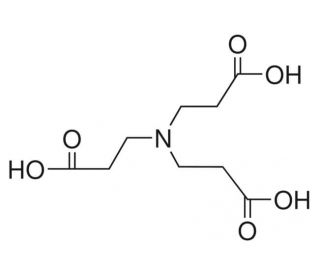

Nitrilotripropionic acid (CAS 817-11-8)
QUICK LINKS
Nitrilotripropionic acid (NTPA) is a versatile compound extensively employed in scientific research for its chelating properties and diverse applications. As a tricarboxylic acid, NTPA contains three carboxylic acid groups, conferring it with strong chelating capabilities towards metal ions. Its mechanism of action involves the formation of stable complexes with metal ions through coordination bonds, wherein the carboxylate groups act as ligands. In research, NTPA finds widespread use in various fields such as environmental science, analytical chemistry, and materials science. In environmental science, NTPA is utilized in metal ion sequestration and remediation processes, including wastewater treatment and soil remediation, due to its ability to form insoluble complexes with heavy metals, thereby facilitating their removal from contaminated environments. In analytical chemistry, NTPA serves as a chelating agent in metal ion detection and quantification methods, such as spectrophotometry and chromatography, enabling accurate analysis of metal concentrations in complex samples. Furthermore, in materials science, NTPA is employed in the synthesis of functional materials, catalysts, and nanoparticles, where its chelating properties play a crucial role in controlling material properties and functionalities. Overall, Nitrilotripropionic acid continues to be a valuable tool in scientific research, contributing to advancements across various disciplines through its versatile chelating capabilities and broad range of applications.
Nitrilotripropionic acid (CAS 817-11-8) References
- Synthesis and magnetism of oxygen-bridged tetranuclear defect dicubane Co(II) and Ni(II) clusters. | King, P., et al. 2004. Dalton Trans. 2670-6. PMID: 15514750
- Use of proliferation tests to evaluate the effects of complexing agents on beryllium toxicity. | Stephan, CH., et al. 2009. J Appl Toxicol. 29: 27-35. PMID: 18785683
- New tris(hydroxypyridinones) as iron and aluminium sequestering agents: synthesis, complexation and in vivo studies. | Chaves, S., et al. 2010. Chemistry. 16: 10535-45. PMID: 20665585
- Hydroxypyri(mi)dine-based chelators as antidotes of toxicity due to aluminum and actinides. | Santos, MA., et al. 2012. Curr Med Chem. 19: 2773-93. PMID: 22455584
- A novel tripodal tris-hydroxypyrimidinone sequestering agent for trivalent hard metal ions: synthesis, complexation and in vivo studies. | Chaves, S., et al. 2013. Dalton Trans. 42: 6033-45. PMID: 23223558
- Simulated annealing and density functional theoretical prediction of macrocyclic ligand conformations, protonation sites and complex metal-ligand exchange reaction directions. | Chang, CA., et al. 2013. Dalton Trans. 42: 6397-409. PMID: 23462882
- 3-Hydroxypyridinone derivatives as metal-sequestering agents for therapeutic use. | Santos, MA. and Chaves, S. 2015. Future Med Chem. 7: 383-410. PMID: 25826364
- Molecular Pac-Man and Tacos: layered Cu(II) cages from ligands with high binding site concentrations. | McDonald, C., et al. 2015. Dalton Trans. 44: 13359-68. PMID: 26133039
- Tuning receptors for the encapsulation of beryllium2. | Nixon, DJ., et al. 2019. Phys Chem Chem Phys. 21: 19660-19666. PMID: 31469139
Ordering Information
| Product Name | Catalog # | UNIT | Price | Qty | FAVORITES | |
Nitrilotripropionic acid, 1 g | sc-295931 | 1 g | $93.00 | |||
Nitrilotripropionic acid, 5 g | sc-295931A | 5 g | $371.00 |