
Date published: 2026-4-5

1-800-457-3801

SCBT Portrait Logo
Seach Input

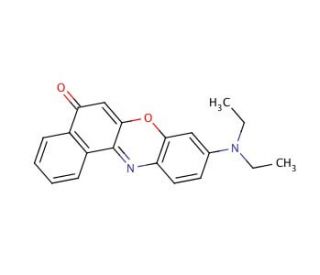
Nile Red (CAS 7385-67-3)

5.0(6)
Write a reviewAsk a question

See product citations (24)

Alternate Names:
Nile Red is also known as 9-(diethylamino)-5H-benzo[a]phenoxazin-5-one and 9-(diethylamino)benzo[a]phenoxazin-5-one.
Application:
Nile Red is a photostable, lipophilic stain with bright red fluorescence that has been used stain cell structures to visualize and localize colloidal drug carriers.
CAS Number:
7385-67-3
Molecular Weight:
318.37
Molecular Formula:
C20H18N2O2
For Research Use Only. Not Intended for Diagnostic or Therapeutic Use.
* Refer to Certificate of Analysis for lot specific data.

QUICK LINKS

Nile Red, a fluorescent dye with the chemical structure C20H18N2O2, is primarily used in scientific research to stain intracellular lipid droplets, enabling the visualization of neutral lipids and phospholipids under fluorescence microscopy. The dye is highly lipophilic and non-polar, which allows it to easily integrate into lipid-rich environments within cells, where it exhibits strong fluorescence. The unique property of Nile Red is its solvatochromic behavior; it fluoresces intensely in hydrophobic environments but remains non-fluorescent in aqueous environments, making it an ideal tool for studying cellular lipid content and distribution. In research, Nile Red has been extensively utilized to investigate lipid accumulation in cells and has proven essential in studies related to lipid metabolism and storage diseases. It has also been adapted for use in environmental science, particularly in the detection and quantification of microplastics in water bodies, due to its ability to bind to plastic particles and fluoresce upon excitation. Additionally, Nile Red′s sensitivity and specificity for lipids have facilitated its use in flow cytometry to differentiate cell populations based on lipid content. This dye thus serves as a critical tool for researchers across multiple fields, including cellular biology, environmental science, and materials science, providing insights into lipid dynamics and environmental contamination.


Nile Red (CAS 7385-67-3) References

  1. Nile Red binding to HepG2 cells: an improved assay for in vitro studies of hepatosteatosis.  |  McMillian, MK., et al. 2001. In Vitr Mol Toxicol. 14: 177-90. PMID: 11846991
  2. Simple liquid-chromatographic method for Nile Red quantification in cell culture in spite of photobleaching.  |  Lamprecht, A. and Benoit, JP. 2003. J Chromatogr B Analyt Technol Biomed Life Sci. 787: 415-9. PMID: 12650763
  3. The use of a fluorescent dye, Nile red, to evaluate the lipid content of single mammalian oocytes.  |  Genicot, G., et al. 2005. Theriogenology. 63: 1181-94. PMID: 15710202
  4. Evaluation of a high-content screening fluorescence-based assay analyzing the pharmacological modulation of lipid homeostasis in human macrophages.  |  Werner, T., et al. 2006. Cytometry A. 69: 200-2. PMID: 16496419
  5. D-threo-1-phenyl-2-decanoylamino-3-morpholino-1-propanol alters cellular cholesterol homeostasis by modulating the endosome lipid domains.  |  Makino, A., et al. 2006. Biochemistry. 45: 4530-41. PMID: 16584188
  6. Non-covalent versus covalent control of self-assembly and chirality of Nile red-modified nucleoside and DNA.  |  Varghese, R. and Wagenknecht, HA. 2010. Chemistry. 16: 9040-6. PMID: 20645354
  7. Quantification of Lipid Abundance and Evaluation of Lipid Distribution in Caenorhabditis elegans by Nile Red and Oil Red O Staining.  |  Escorcia, W., et al. 2018. J Vis Exp.. PMID: 29553519
  8. Nile red as a polarity-sensitive fluorescent probe of hydrophobic protein surfaces.  |  Sackett, DL. and Wolff, J. 1987. Anal Biochem. 167: 228-34. PMID: 3442318
  9. Nile red: a selective fluorescent stain for intracellular lipid droplets.  |  Greenspan, P., et al. 1985. J Cell Biol. 100: 965-73. PMID: 3972906

Ordering Information

Product NameCatalog #UNITPriceQtyFAVORITES

Nile Red, 10 mg

sc-203747
10 mg
$52.00

Nile Red, 250 mg

sc-203747A
250 mg
$124.00

Nile Red, 1 g

sc-203747B
1 g
$205.00

Nile Red, 5 g

sc-203747C
5 g
$916.00

What is the delivery time for Nile Red to Vancouver, BC?

Asked by: Nill
Thank you for your question. For current product availability and delivery times, please contact our Customer Care Department. Please call us toll-free at (800) 457-3801 option 1, e-mail <customercare@scbt.com>, or use the live chat on our website.
Answered by: Technical Support
Date published: 2018-11-20
  • y_2026, m_3, d_26, h_7CST
  • bvseo_bulk, prod_bvqa, vn_bulk_3.0.43
  • cp_1, bvpage1
  • co_hasquestionsanswers, tq_1
  • loc_en_US, sid_203747, prod, sort_[SortEntry(order=LAST_APPROVED_ANSWER_SUBMISSION_TIME, direction=DESCENDING)]
  • clientName_scbt
  • bvseo_sdk, java_sdk, bvseo-4.0.0
  • CLOUD, getContent, 98ms
  • QUESTIONS, PRODUCT
Rated 5 out of 5 by from Dye worked very wellNile Red worked excellently to dye oil. Shipment was fast. Highly recommend.
Date published: 2021-12-31
Rated 5 out of 5 by from Wow!Was delivered quickly and so far has worked very well!
Date published: 2019-03-15
Rated 5 out of 5 by from Great stain for aggresomesHaving read that Nile Red can visualize the aggresome (in addition to liquid droplets) I purchased some to determine if it could be used as such. As can be seen in the figure, MDA231 breast adenocarcinoma cells stained with Nile Red visualize the aggresome structure in 25 uM chloroquine-treated cells (yellow arrow), along with granular contents in both treated and untreated cells.
Date published: 2017-06-05
Rated 5 out of 5 by from very excellentI purchased it 4 months ago and used to identify in smooth muscle cells. The lipid was stained very well with the concentration of 1ug/ml.
Date published: 2017-02-12
Rated 5 out of 5 by from Very pleased with the value and performanceVery pleased with the value and performance of this product! I Stained my 3T3-L1 adipocytes with only 10ug/mL. With fluorescence microscopy, this brilliantly lit up the lipid droplets under the FITC filter, while showed lipid droplets and cytoplasm with the rhodamine filter.
Date published: 2016-01-08
Rated 5 out of 5 by from Various publications cite the use of NileVarious publications cite the use of Nile Red in fluorescence microscopy and flow cytofluorometry. Nile Red is an uncharged, hydrophobic, photostable molecule that strongly fluoresces bright red in hydrophobic environments. -SCBT Publication Review
Date published: 2015-04-09
  • y_2026, m_3, d_26, h_7
  • bvseo_bulk, prod_bvrr, vn_bulk_3.0.43
  • cp_1, bvpage1
  • co_hasreviews, tv_0, tr_6
  • loc_en_US, sid_203747, prod, sort_[SortEntry(order=SUBMISSION_TIME, direction=DESCENDING)]
  • clientName_scbt
  • bvseo_sdk, java_sdk, bvseo-4.0.0
  • CLOUD, getReviews, 9ms
  • REVIEWS, PRODUCT
Nile Red is rated 5.0 out of 5 by 6.
  • y_2026, m_3, d_26, h_7
  • bvseo_bulk, prod_bvrr, vn_bulk_3.0.43
  • cp_1, bvpage1
  • co_hasreviews, tv_0, tr_6
  • loc_en_US, sid_203747, prod, sort_[SortEntry(order=SUBMISSION_TIME, direction=DESCENDING)]
  • clientName_scbt
  • bvseo_sdk, java_sdk, bvseo-4.0.0
  • CLOUD, getAggregateRating, 99ms
  • REVIEWS, PRODUCT