
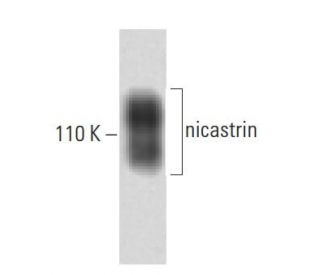

nicastrin Antibody (35): sc-136003
- nicastrin Antibody (35) is a mouse monoclonal IgG2a, cited in 2 publications, provided at 50 µg/500 µl
- raised against amino acids 168-289 of nicastrin of human origin
- recommended for detection of nicastrin of mouse, rat, human and canine origin by WB and IP
- At present, we have not yet completed the identification of the preferred secondary detection reagent(s) for nicastrin Antibody (35). This work is in progress.

QUICK LINKS
SEE ALSO...
nicastrin Antibody (35) is a mouse monoclonal IgG2a antibody that detects nicastrin in mouse, rat, human, and canine samples through western blotting (WB) and immunoprecipitation (IP) applications. Nicastrin is a type I transmembrane glycoprotein that plays a crucial role in the assembly and function of the presenilin complex, which is essential for the proteolytic processing of various substrates, including the β-Amyloid precursor protein (βAPP) and Notch. Nicastrin mediates the signaling pathways associated with Notch and GLP-1 and influences the production of the neurotoxic β-Amyloid peptide, a key factor in the pathogenesis of Familial Alzheimer′s disease (FAD). Nicastrin features hydrophilic amino and carboxy-terminal domains, a short hydrophobic transmembrane domain, and potential sites for post-translational modifications such as N-myristoylation and phosphorylation, which may affect stability and interactions within the presenilin complex. Anti-nicastrin antibody (35) serves as a valuable tool for researchers exploring novel therapeutic strategies aimed at modulating β-Amyloid production in studies related to Alzheimer′s disease and other neurodegenerative conditions.
Alexa Fluor® is a trademark of Molecular Probes Inc., OR., USA
LI-COR® and Odyssey® are registered trademarks of LI-COR Biosciences
nicastrin Antibody (35) References:
- Nicastrin binds to membrane-tethered Notch. | Chen, F., et al. 2001. Nat Cell Biol. 3: 751-4. PMID: 11483961
- The levels of mature glycosylated nicastrin are regulated and correlate with gamma-secretase processing of amyloid beta-precursor protein. | Arawaka, S., et al. 2002. J Neurochem. 83: 1065-71. PMID: 12437577
- Nicastrin is a resident lysosomal membrane protein. | Bagshaw, RD., et al. 2003. Biochem Biophys Res Commun. 300: 615-8. PMID: 12507492
- gamma-Secretase activity requires the presenilin-dependent trafficking of nicastrin through the Golgi apparatus but not its complex glycosylation. | Herreman, A., et al. 2003. J Cell Sci. 116: 1127-36. PMID: 12584255
- The biochemical and genetic odyssey to the function of a nicastrin-like protein. | Haffner, C. and Haass, C. 2004. Neurodegener Dis. 1: 192-5. PMID: 16908989
- Biological and clinical implications of nicastrin expression in invasive breast cancer. | Filipović, A., et al. 2011. Breast Cancer Res Treat. 125: 43-53. PMID: 20224929
- Nicastrin regulates breast cancer stem cell properties and tumor growth in vitro and in vivo. | Lombardo, Y., et al. 2012. Proc Natl Acad Sci U S A. 109: 16558-63. PMID: 23012411
- Synaptic function of nicastrin in hippocampal neurons. | Lee, SH., et al. 2014. Proc Natl Acad Sci U S A. 111: 8973-8. PMID: 24889619
- Nicastrin functions to sterically hinder γ-secretase-substrate interactions driven by substrate transmembrane domain. | Bolduc, DM., et al. 2016. Proc Natl Acad Sci U S A. 113: E509-18. PMID: 26699478
- Nicastrin Deficiency Induces Tyrosinase-Dependent Depigmentation and Skin Inflammation. | Hsu, CH., et al. 2020. J Invest Dermatol. 140: 404-414.e13. PMID: 31437444
Ordering Information
| Product Name | Catalog # | UNIT | Price | Qty | FAVORITES | |
nicastrin Antibody (35) | sc-136003 | 50 µg/500 µl | $322.00 |