
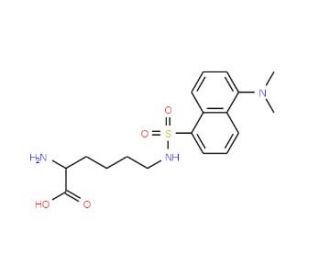

Nε-Dansyl-L-lysine (CAS 1101-84-4)
QUICK LINKS
Nε-Dansyl-L-lysine is a chemical compound derived from L-lysine, an essential amino acid found in proteins. It belongs to the family of dansyl derivatives and is characterized by the attachment of a dansyl group to the epsilon amino group of the lysine residue. This compound has gained significant attention in scientific research due to its unique properties and versatile applications. Nε-Dansyl-L-lysine is widely used as a fluorescent probe and labeling agent in various biochemical and biomedical studies. The dansyl moiety imparts fluorescence properties to the molecule, allowing for sensitive detection and visualization of molecular interactions. In research, Nε-Dansyl-L-lysine has been utilized to study protein-protein interactions, protein structure, and enzymatic activities. By selectively attaching Nε-Dansyl-L-lysine to specific proteins or peptides, researchers can track their localization, monitor conformational changes, and investigate their participation in cellular processes. The fluorescence emitted by Nε-Dansyl-L-lysine serves as useful for understanding the behavior and function of biomolecules. Furthermore, Nε-Dansyl-L-lysine has found applications in the development of biosensors, diagnostic assays, and imaging techniques. Its fluorescence properties enable the detection and quantification of target molecules in complex biological samples. By incorporating Nε-Dansyl-L-lysine into biosensing platforms or imaging agents, researchers can enhance sensitivity and specificity in their experimental designs. Its fluorescence properties and selective labeling capabilities make it an invaluable tool for studying protein dynamics, molecular interactions, and cellular processes. The applications of Nε-Dansyl-L-lysine extend to various scientific disciplines, including biochemistry, molecular biology, biophysics, and diagnostics.
Nε-Dansyl-L-lysine (CAS 1101-84-4) References
- Two-dimensional molecular imprinting approach to produce optical biosensor recognition elements. | Li, X. and Husson, SM. 2006. Langmuir. 22: 9658-63. PMID: 17073493
- Determination of binding conformations of drugs to human serum albumin by transferred nuclear overhauser effect measurements and conformational analyses using high-temperature molecular dynamics calculations. | Matsushita, Y., et al. 1998. J Pharm Sci. 87: 379-86. PMID: 9523993
- Methylated Nepsilon-dansyl-L-lysine as a fluorogenic reagent for the chiral separation of carboxylic acids. | Hayamizu, T., et al. 1998. J Chromatogr B Biomed Sci Appl. 710: 211-8. PMID: 9686889
Ordering Information
| Product Name | Catalog # | UNIT | Price | Qty | FAVORITES | |
Nε-Dansyl-L-lysine, 100 mg | sc-215595 | 100 mg | $54.00 | |||
Nε-Dansyl-L-lysine, 1 g | sc-215595A | 1 g | $247.00 |