
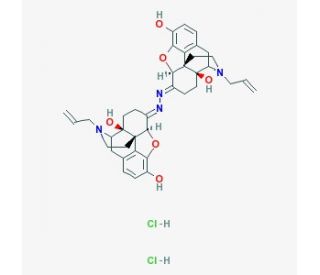

Naloxonazine dihydrochloride (CAS 82824-01-9)
QUICK LINKS
Naloxonazine dihydrochloride is a potent and selective antagonist of the mu-opioid receptor. It functions by competitively inhibiting the binding of endogenous opioids to the mu-opioid receptor, thereby blocking their signaling pathways. Naloxonazine Dihydrochloride′s mechanism of action involves targeting the mu-opioid receptor and preventing the activation of downstream signaling cascades. By doing so, it effectively interferes with the cellular responses mediated by the mu-opioid receptor, without affecting other opioid receptor subtypes. This interference at the molecular level allows for the investigation of the specific role of the mu-opioid receptor in various physiological and pathological processes. In experimental applications, Naloxonazine dihydrochloride is used for elucidating the mechanisms underlying opioid receptor signaling and its potential implications in various biological processes.
Naloxonazine dihydrochloride (CAS 82824-01-9) References
- Effects of the selective mu(1)-opioid receptor antagonist, naloxonazine, on cocaine-induced conditioned place preference and locomotor behavior in rats. | Rademacher, DJ. and Steinpreis, RE. 2002. Neurosci Lett. 332: 159-62. PMID: 12399005
- Antinociception by a peripherally administered novel endomorphin-1 analogue containing beta-proline. | Spampinato, S., et al. 2003. Eur J Pharmacol. 469: 89-95. PMID: 12782189
- Analgesia induced by dietary restriction is mediated by the kappa-opioid system. | de los Santos-Arteaga, M., et al. 2003. J Neurosci. 23: 11120-6. PMID: 14657170
- Response of neuropeptide Y-induced feeding to mu-, delta- and kappa-opioid receptor antagonists in the neonatal chick. | Dodo, K., et al. 2005. Neurosci Lett. 373: 85-8. PMID: 15567558
- Structural determination of the novel fragmentation routes of zwitteronic morphine opiate antagonists naloxonazine and naloxone hydrochlorides using electrospray ionization tandem mass spectrometry. | Joly, N., et al. 2007. Rapid Commun Mass Spectrom. 21: 1062-74. PMID: 17310471
- Evidence for separate involvement of different mu-opioid receptor subtypes in itch and analgesia induced by supraspinal action of opioids. | Andoh, T., et al. 2008. J Pharmacol Sci. 106: 667-70. PMID: 18403901
- Supraspinal administration of apelin-13 induces antinociception via the opioid receptor in mice. | Xu, N., et al. 2009. Peptides. 30: 1153-7. PMID: 19463749
- Peripheral antinociceptive effects of the cyclic endomorphin-1 analog c[YpwFG] in a mouse visceral pain model. | Bedini, A., et al. 2010. Peptides. 31: 2135-40. PMID: 20713109
- Inhibition of morphine-induced cAMP overshoot: a cell-based assay model in a high-throughput format. | Xia, M., et al. 2011. Cell Mol Neurobiol. 31: 901-7. PMID: 21598037
- Food reward-sensitive interaction of ghrelin and opioid receptor pathways in mesolimbic dopamine system. | Kawahara, Y., et al. 2013. Neuropharmacology. 67: 395-402. PMID: 23220294
- Peripheral μ-opioid receptor mediated inhibition of calcium signaling and action potential-evoked calcium fluorescent transients in primary afferent CGRP nociceptive terminals. | Baillie, LD., et al. 2015. Neuropharmacology. 93: 267-73. PMID: 25721395
- The Opioid Interactions of the Antipsychotic Medications Risperidone and Amisulpride in Mice and Their Potential Use in the Treatment of Other Non-Psychotic Medical Conditions. | Schreiber, S. and Pick, CG. 2021. Cell Mol Neurobiol. 41: 1077-1084. PMID: 33184770
- Mechanisms of respiratory depression induced by the combination of buprenorphine and diazepam in rats. | Vodovar, D., et al. 2022. Br J Anaesth. 128: 584-595. PMID: 34872716
Ordering Information
| Product Name | Catalog # | UNIT | Price | Qty | FAVORITES | |
Naloxonazine dihydrochloride, 10 mg | sc-203152 | 10 mg | $156.00 |