
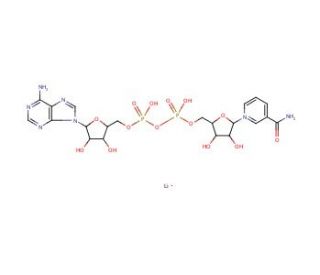

NAD+, Lithium Salt 의 분자 구조, CAS 번호: 64417-72-7
NAD+, Lithium Salt (CAS 64417-72-7)
적용:
NAD+, Lithium Salt 는 생물학적 산화에 활성인 주요 전자 수용체 화합물입니다.
CAS 등록번호:
64417-72-7
순도:
≥90%
분자량:
669.4
분자식:
C21H26N7O14P2Li
연구용으로만 사용가능합니다. 진단이나 치료용으로 사용불가합니다.
* Refer to Certificate of Analysis for lot specific data.
빠른 링크
주문정보
설명
기술정보
안전정보
SDS 및 분석 증명서
NAD+, 리튬염은 리튬 이온이 NAD+ 분자의 음전하를 중화하는 데 사용되는 니코틴아마이드 아데닌 디뉴클레오티드의 변형이다. 연구에서 이 염 형태는 효소 반응과 탈수소효소와 관련된 연구에 특히 유용하며, 여기서 산화환원 반응에 필수적인 조효소로 작용한다. NAD+, 리튬염은 세포 미토콘드리아 내의 전자 수송 사슬에 참여하여 대사 경로와 에너지 생산을 조사하는 데 사용된다. 또한 ADP-리보실트랜스퍼라제의 기질로서의 역할을 고려할 때 DNA 복구 연구에도 중요하다. 또한 연구자들은 NAD+, 리튬염을 분석에 사용하여 세포 조절, 스트레스 반응 및 유전체 안정성 유지를 이해하는 데 중요한 역할을 한다.
NAD+, Lithium Salt (CAS 64417-72-7) 참고자료
- 가역적 아연 억제에 의한 효소 조절: 글리세롤 인산염 탈수소효소를 예로 들어 설명합니다. | Maret, W., et al. 2001. Chem Biol Interact. 130-132: 891-901. PMID: 11306104
- 37°C에서 효소의 촉매 활성 농도 측정을 위한 IFCC 1차 참조 절차 3부. 젖산 탈수소 효소의 촉매 농도 측정을 위한 참조 절차. | Schumann, G., et al. 2002. Clin Chem Lab Med. 40: 643-8. PMID: 12211663
- 고정 효소 반응기와 흑연 전극을 사용한 실제 우유 샘플의 l- 및 d- 젖산염 분석. | Marrazza, G., et al. 1994. Talanta. 41: 1007-14. PMID: 18966029
- 효소의 촉매 농도 측정을 위한 IFCC 참조 절차: 정오표, 참고 사항 및 유용한 조언. 국제 임상 화학 및 진단검사의학 연맹(IFCC)--IFCC 과학 부문. | Schumann, G., et al. 2010. Clin Chem Lab Med. 48: 615-21. PMID: 20298135
- 과분극화된 l-[1-(13)C,U-(2)H]젖산염에서 수소/중수소 교환을 측정하여 종양에서 젖산염 탈수소효소 활성을 조사합니다. | Kennedy, BW., et al. 2012. J Am Chem Soc. 134: 4969-77. PMID: 22316419
- 에스테르 가수분해 중 알데히드 탈수소효소 반응 경로의 일부 역전. | Duncan, RJ. 1979. Biochem J. 183: 459-62. PMID: 230823
- 고친화성 및 저친화성 페길화 헤모글로빈 기반 산소 운반체: 기니피그 수혈 모델에서의 차등 산화 스트레스. | Alomari, E., et al. 2018. Free Radic Biol Med. 124: 299-310. PMID: 29920341
- 아데노신-5'-모노노티네이트(AMN) 삼수화물의 구조: 분자 내 적층 테스트를 위한 NAD의 유사체입니다. | Ramasubbu, N. and Parthasarathy, R. 1988. Acta Crystallogr C. 44 (Pt 12): 2140-4. PMID: 3270554
- 심바스타틴은 PGC-1α 골격근 발현에 따라 생쥐의 포도당 항상성을 손상시킵니다. | Panajatovic, MV., et al. 2020. Biomedicines. 8: PMID: 32942550
- 피리독살 5'-인산염에 의한 마우스 고환 젖산 탈수소효소의 변형. | Gould, KG. and Engel, PC. 1980. Biochem J. 191: 365-71. PMID: 6786279
- 피루베이트 탈카르복실화 효소는 분지 사슬 2-옥소산의 탈카르복실화를 촉매하지만 사카로미세스 세레비지애의 동체 알코올 생산에는 필수적이지 않습니다. | ter Schure, EG., et al. 1998. Appl Environ Microbiol. 64: 1303-7. PMID: 9546164
- Hitachi 911 분석기를 사용하여 자동화된 옥살산염의 효소 분석법. | Langman, LJ. and Allen, LC. 1998. Clin Biochem. 31: 429-32. PMID: 9721445
주문정보
| 제품명 | 카탈로그 번호 | 단위 | 가격 | 수량 | 관심품목 | |
NAD+, Lithium Salt, 1 g | sc-208085 | 1 g | $272.00 |