
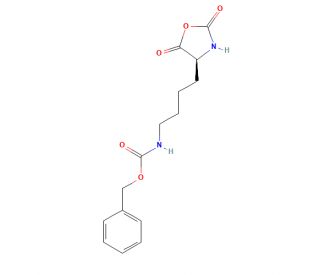

N6-Carbobenzoxy-L-lysine N-Carboxyanhydride (CAS 1676-86-4)
QUICK LINKS
N6-Carbobenzoxy-L-lysine N-Carboxyanhydride (N6-CBZ-L-Lys-NCA) is a critical reagent in the realm of organic synthesis and peptide chemistry. It facilitates the creation of diverse peptides, peptidomimetics, and other molecules. Its mild and selective nature sets it apart from other reagents like dicyclohexylcarbodiimide (DCC) and N-hydroxysuccinimide (NHS), making it useful in organic synthesis. Its application extends to the production of various cyclic, constrained, and macrocyclic peptides, as well as small molecules, polymers, and polypeptides. One of its standout features is its ability to establish a stable carbamate bond between the carboxylic acid group of the N6-Carbobenzoxy-L-lysine N-Carboxyanhydride and the carboxyanhydride group of the NCA. This bond is more steadfast than the amide bonds formed by other reagents, less susceptible to hydrolysis, and thus contributes to N6-Carbobenzoxy-L-lysine N-Carboxyanhydride being a more selective and milder reagent for peptide and peptidomimetic synthesis.
N6-Carbobenzoxy-L-lysine N-Carboxyanhydride (CAS 1676-86-4) References
- Multistage Delivery Nanoparticle Facilitates Efficient CRISPR/dCas9 Activation and Tumor Growth Suppression In Vivo. | Liu, Q., et al. 2019. Adv Sci (Weinh). 6: 1801423. PMID: 30643726
- NanoRNP Overcomes Tumor Heterogeneity in Cancer Treatment. | Liu, Q., et al. 2019. Nano Lett. 19: 7662-7672. PMID: 31593471
- Multi-stimuli-responsive nanomicelles fabricated using synthetic polymer polylysine conjugates for tumor microenvironment dependent drug delivery. | Augustine, R., et al. 2020. J Mater Chem B. 8: 5745-5755. PMID: 32519736
- Precise delivery of doxorubicin and imiquimod through pH-responsive tumor microenvironment-active targeting micelles for chemo- and immunotherapy. | Wen, YH., et al. 2022. Mater Today Bio. 17: 100482. PMID: 36388459
- Peptide-Crosslinked, Highly Entangled Hydrogels with Excellent Mechanical Properties but Ultra-Low Solid Content. | Liu, P., et al. 2023. Adv Mater. 35: e2210021. PMID: 36754047
Ordering Information
| Product Name | Catalog # | UNIT | Price | Qty | FAVORITES | |
N6-Carbobenzoxy-L-lysine N-Carboxyanhydride, 1 g | sc-504621 | 1 g | $460.00 |