
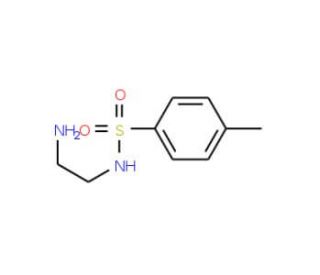

N-Tosylethylenediamine (CAS 14316-16-6)
QUICK LINKS
N-Tosylethylenediamine is a sulfonamide compound extensively explored for its diverse applications in scientific research. N-Tosylethylenediamine manifests as a white crystalline solid with notable solubility in water, ethanol, and various organic solvents. Its efficacy as an amine-based compound makes it useful in laboratory applications, particularly for synthesizing a wide range of compounds. N-Tosylethylenediamine finds extensive utility within the scientific research realm, functioning as an intermediate in the synthesis of various compounds. N-Tosylethylenediamine plays a pivotal role in the formation of metal complexes, including cobalt and nickel complexes. Additionally, N-Tosylethylenediamine contributes to the synthesis of diverse polymers, such as polyurethanes and polyamides. The mechanism of action for N-Tosylethylenediamine revolves around its role as a nucleophile. As such, it readily donates electrons to form bonds with electron-deficient atoms. This reactivity enables it to engage in reactions with molecules, particularly those present in metal complexes and polymers. Furthermore, it exhibits base properties, allowing it to accept protons from other molecules and establish new bonds.
N-Tosylethylenediamine (CAS 14316-16-6) References
- Highly enantioselective hydrogenation of quinolines using phosphine-free chiral cationic ruthenium catalysts: scope, mechanism, and origin of enantioselectivity. | Wang, T., et al. 2011. J Am Chem Soc. 133: 9878-91. PMID: 21574550
- Single operation palladium catalysed C(sp3)-H functionalisation of tertiary aldehydes: investigations into transient imine directing groups. | St John-Campbell, S., et al. 2017. Chem Sci. 8: 4840-4847. PMID: 28959406
- Scope and Limitations of Reductive Amination Catalyzed by Half-Sandwich Iridium Complexes Under Mild Reaction Conditions. | Nguyen, DP., et al. 2020. Tetrahedron Lett. 61: PMID: 32728300
- Recent advances in nanomedicines for photodynamic therapy (PDT)-driven cancer immunotherapy. | Ji, B., et al. 2022. Theranostics. 12: 434-458. PMID: 34987658
- Targeting Bone Tumor and Subcellular Endoplasmic Reticulum via Near Infrared II Fluorescent Polymer for Photodynamic-Immunotherapy to Break the Step-Reduction Delivery Dilemma. | Zhang, X., et al. 2022. Adv Sci (Weinh). 9: e2201819. PMID: 35754296
- Nanodrugs Manipulating Endoplasmic Reticulum Stress for Highly Effective Antitumor Therapy. | Xiang, Y., et al. 2022. Front Pharmacol. 13: 949001. PMID: 35903337
- Endoplasmic Reticulum-Targeting Two-Photon Fluorescent Probe for CYP1A Activity and Its Imaging Application in Endoplasmic Reticulum Stress. | Shi, C., et al. 2023. Molecules. 28: PMID: 37110706
Ordering Information
| Product Name | Catalog # | UNIT | Price | Qty | FAVORITES | |
N-Tosylethylenediamine, 5 g | sc-228743 | 5 g | $95.00 |