
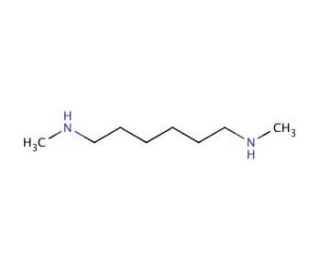

N,N′-Dimethyl-1,6-hexanediamine (CAS 13093-04-4)
LINKS RÁPIDOS
A N,N'-Dimetil-1,6-hexanodiamina (DMHD) é um composto orgânico classificado como uma diamina alifática. Este líquido incolor e volátil emite um forte odor a amoníaco. Com a sua versatilidade, a N,N'-Dimetil-1,6-hexanodiamina encontra aplicações generalizadas nos domínios da química e da bioquímica. Em química e bioquímica, a N,N'-Dimetil-1,6-hexanodiamina é um reagente valioso em vários ensaios. Provou ser útil como substrato na determinação das actividades enzimáticas, incluindo aminotransferases, amidases e carboxipeptidases. Além disso, os investigadores utilizam-no para detetar proteínas específicas e estudar as interacções proteína-proteína. Além disso, a N,N'-Dimetil-1,6-hexanodiamina desempenha um papel na síntese de polímeros, tensioactivos e catalisadores. O seu envolvimento nestes processos aumenta a sua importância em diversas aplicações industriais. Embora não seja completamente compreendido, o mecanismo de ação da N,N'-Dimetil-1,6-hexanodiamina envolve a atuação como catalisador na reação de Hofmann-Löffler, uma reação de condensação. Acredita-se também que funcione como um agente quelante, promovendo a estabilização dos produtos da reação. A N,N'-Dimetil-1,6-hexanodiamina, com as suas várias aplicações e funções, é uma promessa significativa para o avanço da investigação científica e dos processos industriais.
N,N′-Dimethyl-1,6-hexanediamine (CAS 13093-04-4) Referencias
- Poli(aminoálcoois ésteres) degradáveis como potenciais vectores de ADN com baixa citotoxicidade. | Jon, S., et al. 2003. Biomacromolecules. 4: 1759-62. PMID: 14606906
- Direcionamento de fluoróforos para proteínas celulares através da ligação de azidas mediada por enzimas e da cicloadição promovida por estirpes. | Yao, JZ., et al. 2012. J Am Chem Soc. 134: 3720-8. PMID: 22239252
- Síntese dos primeiros poli(diaminossulfuretos) e investigação das suas aplicações como veículos de administração de medicamentos. | Yoo, J., et al. 2012. Macromolecules. 45: 688-697. PMID: 22347726
- Nova classe de polímeros biodegradáveis formados a partir de reacções de um grupo funcional inorgânico. | Yoo, J., et al. 2012. Macromolecules. 45: 2292-2300. PMID: 22454554
- Libertação de óxido nítrico de poliuretanos à base de polidimetilsiloxano. | Nguyen, EB., et al. 2014. J Appl Biomater Funct Mater. 12: 172-82. PMID: 24744231
- Síntese e atividade interfacial de novas sulfobetaínas heterogéneas em solução aquosa. | Kwaśniewska, D., et al. 2015. J Surfactants Deterg. 18: 477-486. PMID: 25814830
- Avanços recentes em polímeros tromboresistentes e antimicrobianos para aplicações biomédicas: basta dizer sim ao óxido nítrico (NO). | Wo, Y., et al. 2016. Biomater Sci. 4: 1161-83. PMID: 27226170
- Avanços em Suportes Poliméricos Híbridos Orgânicos e Orgânicos-Inorgânicos para Aplicações Catalíticas. | Salvo, AM., et al. 2016. Molecules. 21: PMID: 27689980
- Agregação de nanopartículas de prata induzida por corante de rodamina multimérico para dispersão Raman melhorada pela superfície. | Bartolowits, MD., et al. 2019. ACS Omega. 4: 140-145. PMID: 30729221
- Poliamidoaminas hidrofóbicas semi-cristalinas: Uma nova família de materiais tecnológicos? | Marcioni, M., et al. 2021. Polymers (Basel). 13: PMID: 33806055
- Eficácia antimicrobiana de alguns dióxidos de N,N'-dialquil-N,N'-dimetil-1,6-hexanodiamina. | Mlynarcík, D., et al. 1979. Folia Microbiol (Praha). 24: 188-90. PMID: 378783
Informacoes sobre ordens
| Nome do Produto | Numero de Catalogo | UNID | Preco | Qde | FAVORITOS | |
N,N′-Dimethyl-1,6-hexanediamine, 1 g | sc-228797 | 1 g | $68.00 |