
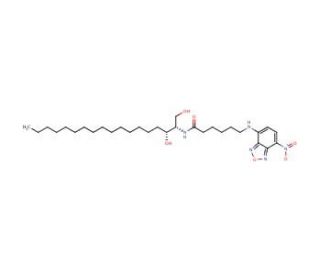

N-(NBD-Aminocaproyl)sphinganine
QUICK LINKS
N-(NBD-Aminocaproyl)sphinganine is a synthetic compound widely utilized in research to investigate sphingolipid metabolism and cellular signaling pathways. This chemical serves as a valuable tool for studying the dynamics and functions of sphinganine, a key precursor in the biosynthesis of sphingolipids. Its mechanism of action involves mimicking endogenous sphinganine, thereby allowing researchers to trace its metabolic fate and biological activities within cells. Specifically, N-(NBD-Aminocaproyl)sphinganine is often employed to explain the roles of sphingolipids in various cellular processes, including apoptosis, cell cycle regulation, and membrane trafficking. By fluorescently labeling sphinganine, researchers can visualize its subcellular localization and interactions with other biomolecules using advanced imaging techniques. Additionally, this chemical has been instrumental in deciphering the molecular mechanisms underlying sphingolipid-related diseases, such as cancer, neurodegenerative disorders, and metabolic syndromes. Through its precise labeling and versatile applications, N-(NBD-Aminocaproyl)sphinganine continues to advance our understanding of sphingolipid biology and its implications in health and disease.
N-(NBD-Aminocaproyl)sphinganine References
- Preparation of fluorescence-labeled GM1 and sphingomyelin by the reverse hydrolysis reaction of sphingolipid ceramide N-deacylase as substrates for assay of sphingolipid-degrading enzymes and for detection of sphingolipid-binding proteins. | Nakagawa, T., et al. 1999. J Biochem. 126: 604-11. PMID: 10467178
- Sorting of sphingolipids in the endocytic pathway of HT29 cells. | Kok, JW., et al. 1991. J Cell Biol. 114: 231-9. PMID: 2071671
- Normal- and reverse-phase HPLC separations of fluorescent (NBD) lipids. | Martin, OC. and Pagano, RE. 1986. Anal Biochem. 159: 101-8. PMID: 3812987
- Loss of Drs2p does not abolish transfer of fluorescence-labeled phospholipids across the plasma membrane of Saccharomyces cerevisiae. | Siegmund, A., et al. 1998. J Biol Chem. 273: 34399-405. PMID: 9852106
Ordering Information
| Product Name | Catalog # | UNIT | Price | Qty | FAVORITES | |
N-(NBD-Aminocaproyl)sphinganine, 50 µg | sc-301239 | 50 µg | $42.00 |