
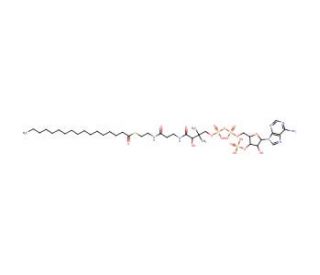

n-Heptadecanoyl coenzyme A lithium salt (CAS 3546-17-6)
빠른 링크
n-헵타데카노일 코엔자임 A 리튬염은 지질 대사 및 효소 활성을 연구하는 생화학 연구에 사용되는 중요한 지방 아실-CoA 유도체입니다. 헵타데카노산과 코엔자임 A가 결합된 이 화합물은 지방산 산화 및 합성에 관여하는 다양한 아실-CoA 탈수소효소, 티오에스테라아제 및 기타 효소의 기질로 사용됩니다. 연구자들은 n-헵타데카노일 CoA를 사용하여 이러한 효소의 특정 촉매 메커니즘을 조사하여 장쇄 지방산의 분해와 합성을 촉진하는 방법에 대한 통찰력을 제공합니다. 대사 연구에서 n-헵타데카노일 CoA는 지방산 대사 경로를 추적하는 데 사용되어 β-산화 주기에서 다양한 효소의 역할을 설명하는 데 도움이 됩니다. 이러한 경로에서의 역할은 미토콘드리아 기능 및 에너지 생산을 연구하는 데 유용한 도구입니다. 동위원소 표지된 형태의 n-헵타데카노일 CoA를 통합함으로써 연구자들은 세포 내 지방산의 대사 운명을 추적하여 대사 흐름과 지질 항상성 조절에 대한 자세한 정보를 제공할 수 있습니다. 또한 n-헵타데카노일 CoA는 효소 분석에 사용되어 아실-CoA 결합 단백질과 수송체의 동역학 및 기질 특이성을 결정합니다. 이러한 연구는 세포 과정에서 지방산의 수송과 활용을 이해하는 데 매우 중요합니다. 또한 현재 연구는 지질 관련 효소 및 수용체의 활성을 조절하는 잠재적 역할을 탐구하면서 n-헵타데카노일 CoA와 지질 신호 전달 경로의 상호 작용에 초점을 맞추고 있습니다. 전반적으로 이 화합물은 지질 대사와 세포 에너지 균형을 유지하는 복잡한 생화학 경로에 대한 지식을 발전시키는 데 필수적입니다.
n-Heptadecanoyl coenzyme A lithium salt (CAS 3546-17-6) 참고자료
- 로시글리타존은 아디포넥틴이 없는 생쥐의 간에서 지방 아실 CoA 축적과 과도한 글리코겐 저장을 촉진합니다. | Zhou, M., et al. 2010. J Hepatol. 53: 1108-16. PMID: 20828853
- 쥐에서 수컷 생식독성 효과의 시작 사건으로서 벤조일-CoA 공액 축적? 구조-활성 분석, 종 특이성 및 생체 내 관련성. | Laue, H., et al. 2020. Arch Toxicol. 94: 4115-4129. PMID: 33057782
- 장쇄 지방 아실 코엔자임 A는 NME1/2를 억제하고 암 전이를 조절합니다. | Zhang, S., et al. 2022. Proc Natl Acad Sci U S A. 119: e2117013119. PMID: 35259022
주문정보
| 제품명 | 카탈로그 번호 | 단위 | 가격 | 수량 | 관심품목 | |
n-Heptadecanoyl coenzyme A lithium salt, 5 mg | sc-215461 | 5 mg | $312.00 |