
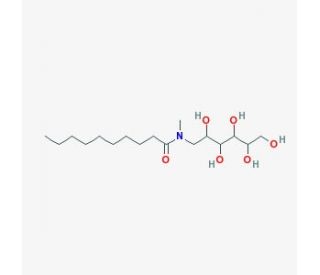

N-Decanoyl-N-methylglucamine (CAS 85261-20-7)
QUICK LINKS
N-Decanoyl-N-methylglucamine, commonly known as MEGA-10, is a non-ionic detergent widely utilized in scientific research due to its unique properties and versatile applications. Its mechanism of action involves disrupting lipid-lipid and lipid-protein interactions within biological membranes, effectively solubilizing membrane proteins while maintaining their native structure and function. In research, MEGA-10 is extensively employed in various biochemical and biophysical techniques, including protein purification, membrane protein extraction, and structural biology studies. Its ability to solubilize membrane proteins without denaturation makes it particularly valuable in preserving the native conformation of integral membrane proteins during isolation and purification processes. Additionally, MEGA-10 finds applications in lipidomics research for solubilizing lipids and in lipid bilayer studies for stabilizing lipid vesicles for biophysical assays. Ongoing research continues to explore novel uses and formulations of MEGA-10, highlighting its significance as a crucial tool in elucidating membrane biology, protein-lipid interactions, and the structural and functional properties of biomolecules.
N-Decanoyl-N-methylglucamine (CAS 85261-20-7) References
- Effect of surfactants on wetting of super-hydrophobic surfaces. | Mohammadi, R., et al. 2004. Langmuir. 20: 9657-62. PMID: 15491199
- Optimal concentrations of N-decanoyl-N-methylglucamine and sodium dodecyl sulfate allow the extraction and analysis of membrane proteins. | Chuang, JH., et al. 2011. Anal Biochem. 418: 298-300. PMID: 21871431
- Gadolinium(III) Complexes with N-Alkyl-N-methylglucamine Surfactants Incorporated into Liposomes as Potential MRI Contrast Agents. | Silva, SR., et al. 2015. Bioinorg Chem Appl. 2015: 942147. PMID: 26347596
- A study on the interaction of horse heart cytochrome c with some conventional and ionic liquid surfactants probed by ultraviolet-visible and fluorescence spectroscopic techniques. | Mondal, S. and Das, B. 2018. Spectrochim Acta A Mol Biomol Spectrosc. 198: 278-282. PMID: 29554518
- Nonionic detergents increase the stoichiometry of ligand binding to the rat hepatic galactosyl receptor. | Ray, DA., et al. 1986. Biochemistry. 25: 6097-103. PMID: 3024701
- Further Step toward a Comprehensive Understanding of the Effect of Surfactant Additions on Altering the Impact Dynamics of Water Droplets. | Esmaeili, AR., et al. 2021. Langmuir. 37: 841-851. PMID: 33397113
- Impact Dynamics and Freezing Behavior of Surfactant-Laden Droplets on Non-Wettable Coatings at Subzero Temperatures. | Esmaeili, AR., et al. 2021. Langmuir. 37: 11049-11060. PMID: 34498877
- N-D-Gluco-N-methylalkanamide compounds, a new class of non-ionic detergents for membrane biochemistry. | Hildreth, JE. 1982. Biochem J. 207: 363-6. PMID: 7159387
- Micelle size modulation and phase behavior in MEGA-10/Triton X-100 mixtures | Naous, M., Molina-Bolívar, J. A., & Ruiz, C. C. 2014. Thermochimica acta. 598: 68-76.
- Molecular thermodynamic modeling of the specific effect of salt on the aggregation of nonionic surfactants | Koroleva, S. V., Korchak, P., & Victorov, A. I. 2019. Journal of Chemical & Engineering Data. 65(3): 987-992.
Ordering Information
| Product Name | Catalog # | UNIT | Price | Qty | FAVORITES | |
N-Decanoyl-N-methylglucamine, 500 mg | sc-281067 | 500 mg | $37.00 |