
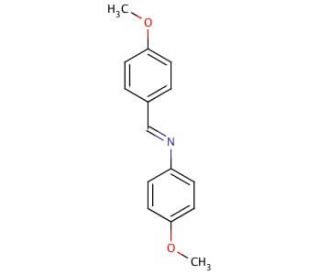

N-(4-Methoxybenzylidene)-4-methoxyaniline (CAS 1749-08-2)
QUICK LINKS
MBMA, or N-(4-Methoxybenzylidene)-4-methoxyaniline, is a chemical compound that has captured considerable attention within the scientific community due to its distinct properties and potential applications. Derived from aniline, N-(4-Methoxybenzylidene)-4-methoxyaniline finds widespread use in organic synthesis and chemistry. Extensive research has been conducted on N-(4-Methoxybenzylidene)-4-methoxyaniline, exploring its possible applications in various fields. Notably, it shows great promise in the realm of organic semiconductors. Thanks to its exceptional charge mobility and stability, N-(4-Methoxybenzylidene)-4-methoxyaniline emerges as a strong contender for synthesizing organic semiconductors. Scientists have successfully utilized it in creating organic field-effect transistors (OFETs) and organic photovoltaic devices (OPVs). While the exact mechanism of action of N-(4-Methoxybenzylidene)-4-methoxyaniline remains elusive, it is believed to interact with cellular proteins and enzymes, leading to alterations in their activity. Notably, N-(4-Methoxybenzylidene)-4-methoxyaniline has shown the ability to inhibit the activity of specific enzymes, such as tyrosinase and cholinesterase. Additionally, reports indicate that N-(4-Methoxybenzylidene)-4-methoxyaniline exhibits antioxidant and anti-inflammatory properties. N-(4-Methoxybenzylidene)-4-methoxyaniline, or MBMA, has garnered significant scientific interest due to its unique characteristics and its potential contributions to organic semiconductor development and applications. Ongoing research continues to shed light on its intriguing properties and applications.
N-(4-Methoxybenzylidene)-4-methoxyaniline (CAS 1749-08-2) References
- Torsional vibration and central bond length of N-benzylideneanilines. | Harada, J., et al. 2004. Acta Crystallogr B. 60: 578-88. PMID: 15367793
Ordering Information
| Product Name | Catalog # | UNIT | Price | Qty | FAVORITES | |
N-(4-Methoxybenzylidene)-4-methoxyaniline, 1 g | sc-228639 | 1 g | $21.00 |