
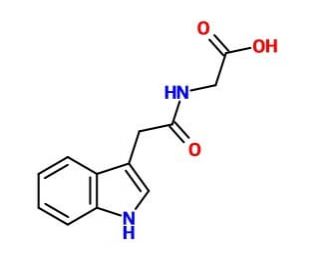

N-(3-Indoleacetyl)glycine (CAS 13113-08-1)
QUICK LINKS
N-(3-Indoleacetyl)glycine, also referred to as N-[1H-Indol-3-YL-acetyl]glycine acid, holds great significance in scientific research due to its distinct biological and chemical properties. Over the past years, this compound has garnered considerable attention and has been extensively examined. N-(3-Indoleacetyl)glycine has been employed in laboratory experiments to investigate the inhibition of specific enzymes, such as tyrosinase and glutamate dehydrogenase. Additionally, it has played a role in studies focusing on protein structure and function, as well as cellular biochemistry. While the precise mechanism of action of N-(3-Indoleacetyl)glycine remains elusive, it is believed to function as an inhibitor of select enzymes like tyrosinase and glutamate dehydrogenase. Furthermore, it is thought to interact with proteins, inducing alterations in their structure and function. Additionally, N-(3-Indoleacetyl)glycine may interact with DNA, leading to modifications in gene expression.
N-(3-Indoleacetyl)glycine (CAS 13113-08-1) References
- Novel allosteric effectors of the tryptophan synthase alpha(2)beta(2) complex identified by computer-assisted molecular modeling. | Marabotti, A., et al. 2000. Biochim Biophys Acta. 1476: 287-99. PMID: 10669793
- Effects of first dimension eluent composition in two-dimensional liquid chromatography. | Li, X. and Carr, PW. 2011. J Chromatogr A. 1218: 2214-21. PMID: 21411103
- Flavan-3-ol/Procyanidin Metabolomics in Rat Urine Using HPLC-Quadrupole TOF/MS. | Masumoto, S., et al. 2018. Mol Nutr Food Res. 62: e1700867. PMID: 29577618
- Genetic variation in YIGE1 contributes to ear length and grain yield in maize. | Luo, Y., et al. 2022. New Phytol. 234: 513-526. PMID: 34837389
- Plant Hormone Response to Low-Temperature Stress in Cold-Tolerant and Cold-Sensitive Varieties of Zanthoxylum bungeanum Maxim. | Tian, J., et al. 2022. Front Plant Sci. 13: 847202. PMID: 35574137
- Transcriptomics and metabolomics reveal effect of arbuscular mycorrhizal fungi on growth and development of apple plants. | Jing, S., et al. 2022. Front Plant Sci. 13: 1052464. PMID: 36388499
- Roles of Hormones in Elevated pH-Mediated Mitigation of Copper Toxicity in Citrus sinensis Revealed by Targeted Metabolome. | Zhang, J., et al. 2023. Plants (Basel). 12: PMID: 37299123
- Integrated physicochemical, hormonal, and transcriptomic analysis reveals the underlying mechanism of callus formation in Pinellia ternata hydroponic cuttings. | Duan, X., et al. 2023. Front Plant Sci. 14: 1189499. PMID: 37409296
- Physiological, Metabolic, and Transcriptomic Analyses Reveal Mechanisms of Proliferation and Somatic Embryogenesis of Litchi (Litchi chinensis Sonn.) Embryogenic Callus Promoted by D-Arginine Treatment. | Cao, L., et al. 2024. Int J Mol Sci. 25: PMID: 38612774
- GUO, Xinyu, et al. Root cell wall remodeling mediates copper oxide nanoparticles phytotoxicity on lettuce (Lactuca sativa L.) | Guo, X., et al. 2022. Environmental and Experimental Botany. 200: 104906.
Ordering Information
| Product Name | Catalog # | UNIT | Price | Qty | FAVORITES | |
N-(3-Indoleacetyl)glycine, 25 mg | sc-257808 | 25 mg | $52.00 | |||
N-(3-Indoleacetyl)glycine, 50 mg | sc-257808A | 50 mg | $104.00 |