
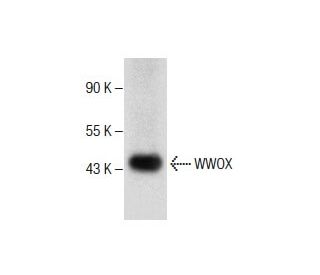


mouse ovary extract: sc-2404
- 500 µg protein in 200 µl SDS-PAGE Western blotting buffer
- Western blotting positive control
- recommended use is 50 µg (20 µl) per lane
- extracts should be stored at -20°C and repeated freezing and thawing should be minimized
- sample vial should be placed at 95° C for up to 5 minutes, once prior to use

QUICK LINKS
SEE ALSO...
Mouse ovary extract, derived from the ovarian tissue of mice, has been extensively utilized in scientific research to investigate various biological mechanisms related to reproductive biology. This extract contains a complex mixture of proteins, hormones, growth factors, and other cellular components obtained from the ovaries, the female reproductive organs responsible for oocyte development, folliculogenesis, and hormone synthesis. The specific mechanisms of action attributed to mouse ovary extract are diverse and complex. Researchers have employed this extract to study follicular development, oocyte maturation, and hormonal regulation in the ovaries. By exposing ovarian cell cultures or experimental models to mouse ovary extract, scientists have gained insights into the effects of its components on cellular processes, such as follicle growth, steroidogenesis, and gene expression. Additionally, this extract has been used to examine the role of specific proteins or molecules present in the ovaries in various reproductive contexts. The use of mouse ovary extract in research has provided valuable knowledge regarding the complex processes involved in female reproductive physiology and the molecular mechanisms governing ovarian function. It continues to be an indispensable tool for studying reproductive biology, advancing our understanding of fertility, and investigating the interplay between cellular components within the ovaries.
mouse ovary extract References:
- Developmental regulation and expression of the zebrafish connexin43 gene. | Chatterjee, B., et al. 2005. Dev Dyn. 233: 890-906. PMID: 15895415
- Gonadotropin control of inhibin secretion and the relationship to follicle type and number in the hpg mouse. | Wang, Y., et al. 2005. Biol Reprod. 73: 610-8. PMID: 15917350
- Chemotaxis assays of mouse sperm on microfluidic devices. | Koyama, S., et al. 2006. Anal Chem. 78: 3354-9. PMID: 16689537
- Oocyte-specific factors bind a conserved upstream sequence required for mouse zona pellucida promoter activity. | Millar, SE., et al. 1991. Mol Cell Biol. 11: 6197-204. PMID: 1944285
- Mouse oocytes connect with granulosa cells by fusing with cell membranes and form a large complex during follicle development. | Komatsu, K. and Masubuchi, S. 2018. Biol Reprod. 99: 527-535. PMID: 29590310
- Conservation of mammalian secondary sperm receptor genes enables the promoter of the human gene to function in mouse oocytes. | Liang, LF. and Dean, J. 1993. Dev Biol. 156: 399-408. PMID: 8385033
Ordering Information
| Product Name | Catalog # | UNIT | Price | Qty | FAVORITES | |
mouse ovary extract | sc-2404 | 500 µg/200 µl | $120.00 |