
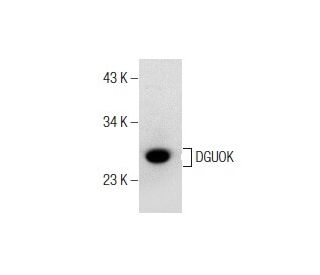


mouse kidney extract: sc-2255
- 500 µg protein in 200 µl SDS-PAGE Western blotting buffer
- Western blotting positive control
- recommended use is 50 µg (20 µl) per lane
- extracts should be stored at -20°C and repeated freezing and thawing should be minimized
- sample vial should be placed at 95° C for up to 5 minutes, once prior to use

QUICK LINKS
SEE ALSO...
Mouse kidney extract, derived from the kidney tissue of mice, has been extensively utilized in scientific research to investigate various biological mechanisms related to renal physiology and kidney biology. This extract contains a complex mixture of proteins, enzymes, metabolites, and other cellular components obtained from the kidneys, the vital organs responsible for filtration, fluid balance, and waste excretion. The specific mechanisms of action associated with mouse kidney extract are diverse and complex. Researchers have employed this extract to study renal cell function, nephron development, and the regulation of kidney-specific processes. By exposing renal cell cultures or experimental models to mouse kidney extract, scientists have gained valuable insights into the effects of its constituents on cellular processes, such as ion transport, reabsorption, and water homeostasis in the kidney. Additionally, this extract has been used to explore the role of specific proteins or molecules present in the kidneys in various renal contexts. The use of mouse kidney extract in research has contributed significantly to our understanding of renal physiology, kidney diseases, and the complex interplay of cellular components within the renal tissue. It continues to be an invaluable tool for investigating fundamental aspects of kidney biology, elucidating renal-specific mechanisms, and unraveling the complexities of renal function.
mouse kidney extract References:
- High-performance liquid chromatographic-fluorimetric assay for cathepsin A (lysosomal protective protein) activity. | Chikuma, T., et al. 1999. J Chromatogr B Biomed Sci Appl. 728: 59-65. PMID: 10379657
- Kidney produces a novel acylated peptide, ghrelin. | Mori, K., et al. 2000. FEBS Lett. 486: 213-6. PMID: 11119706
- A 25 kDa cleavage product of polypyrimidine tract binding protein (PTB) present in mouse tissues prevents PTB binding to the 5′ untranslated region and inhibits translation of hepatitis A virus RNA. | Venkatramana, M., et al. 2003. Virus Res. 98: 141-9. PMID: 14659561
- Cloning and expression of a cDNA encoding mouse kidney D-amino acid oxidase. | Tada, M., et al. 1990. Gene. 90: 293-7. PMID: 1976103
- Comparison of SYPRO Ruby and Flamingo fluorescent stains for application in proteomic research. | Chakravarti, B., et al. 2010. Anal Biochem. 398: 1-6. PMID: 19917264
- Human urinary trypsin inhibitor (urinastatin)-like substance in mouse kidney and its relationships to mouse kidney kallikrein. | Shikimi, T. and Suzuki, S. 1990. Biol Chem Hoppe Seyler. 371: 991-7. PMID: 2076204
- Identification of pro-epidermal growth factor and high molecular weight epidermal growth factors in adult mouse urine. | Lakshmanan, J., et al. 1990. Biochem Biophys Res Commun. 173: 902-11. PMID: 2268351
- Adaptor protein 1 complexes regulate intracellular trafficking of the kidney anion exchanger 1 in epithelial cells. | Almomani, EY., et al. 2012. Am J Physiol Cell Physiol. 303: C554-66. PMID: 22744004
- Involvement of WNK1-mediated potassium channels in the sexual dimorphism of blood pressure. | Yu, G., et al. 2017. Biochem Biophys Res Commun. 485: 255-260. PMID: 28237360
- Two-step purification of mouse kidney ornithine decarboxylase. | Nishiyama, M., et al. 1988. Prep Biochem. 18: 227-38. PMID: 3131757
- Design, synthesis, structure-activity relationship studies, and evaluation of novel GLS1 inhibitors. | Jo, M., et al. 2023. Bioorg Med Chem Lett. 87: 129266. PMID: 37011768
- Multiple species of ornithine decarboxylase in mouse kidney. Effect of testosterone. | Laitinen, SI., et al. 1985. Biochem Int. 10: 559-66. PMID: 3896241
- Unique specificity of mouse angiotensinogen to homologous renin. | Oliver, WJ. and Gross, F. 1966. Proc Soc Exp Biol Med. 122: 923-6. PMID: 4288259
- DL- and meso-dimercaptosuccinic acid: in vitro and in vivo studies with sodium arsenite. | Aposhian, HV., et al. 1983. Toxicol Appl Pharmacol. 69: 206-13. PMID: 6306868
- Production of germ tubes by virulent and attenuated strains of Candida albicans. | Richardson, MD. and Smith, H. 1981. J Infect Dis. 144: 565-9. PMID: 7035580
Ordering Information
| Product Name | Catalog # | UNIT | Price | Qty | FAVORITES | |
mouse kidney extract | sc-2255 | 500 µg/200 µl | $120.00 |