
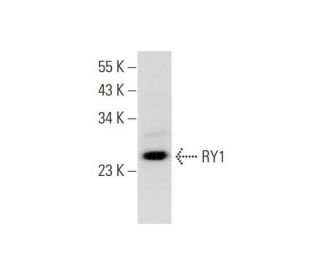


mouse heart extract: sc-2254
- 500 µg protein in 200 µl SDS-PAGE Western blotting buffer
- Western blotting positive control
- recommended use is 50 µg (20 µl) per lane
- extracts should be stored at -20°C and repeated freezing and thawing should be minimized
- sample vial should be placed at 95° C for up to 5 minutes, once prior to use

QUICK LINKS
SEE ALSO...
Mouse heart extract, derived from the heart tissue of mice, has been widely employed in scientific research to investigate various biological mechanisms related to cardiac physiology and heart function. This extract contains a complex mixture of proteins, enzymes, metabolites, and other cellular components obtained from the heart, the central organ of the cardiovascular system responsible for pumping blood and maintaining circulation. The specific mechanisms of action associated with mouse heart extract are diverse and complex. Researchers have utilized this extract to study cardiac cell signaling, contractility, and the regulation of cardiac processes. By exposing cardiac cell cultures or experimental models to mouse heart extract, scientists have gained valuable insights into the effects of its constituents on cellular processes, such as ion channel function, excitation-contraction coupling, and energy metabolism in the heart. Additionally, this extract has been used to explore the role of specific proteins or molecules present in the heart in various cardiac contexts. The use of mouse heart extract in research has contributed significantly to our understanding of cardiac physiology, cardiovascular diseases, and the complex interplay of cellular components within cardiac tissue. It continues to be an invaluable tool for investigating fundamental aspects of heart biology, elucidating cardiac-specific mechanisms, and unraveling the complexities of cardiac function.
mouse heart extract References:
- Induction of antibodies reactive to cardiac myosin and development of heart alterations in cruzipain-immunized mice and their offspring. | Giordanengo, L., et al. 2000. Eur J Immunol. 30: 3181-9. PMID: 11093133
- Cloning and mitochondrial localization of full-length D-AKAP2, a protein kinase A anchoring protein. | Wang, L., et al. 2001. Proc Natl Acad Sci U S A. 98: 3220-5. PMID: 11248059
- Improved liquid chromatographic method for mitoxantrone quantification in mouse plasma and tissues to study the pharmacokinetics of a liposome entrapped mitoxantrone formulation. | Johnson, JL., et al. 2004. J Chromatogr B Analyt Technol Biomed Life Sci. 799: 149-55. PMID: 14659447
- Stereospecific regulation of tyrosine hydroxylase and proenkephalin genes by short-chain fatty acids in rat PC12 cells. | Mally, P., et al. 2004. Pediatr Res. 55: 847-54. PMID: 14739357
- Association of calcineurin with mitochondrial proteins. | Tokheim, AM. and Martin, BL. 2006. Proteins. 64: 28-33. PMID: 16639748
- Shotgun metabolomics approach for the analysis of negatively charged water-soluble cellular metabolites from mouse heart tissue. | Sun, G., et al. 2007. Anal Chem. 79: 6629-40. PMID: 17665876
- Corin is co-expressed with pro-ANP and localized on the cardiomyocyte surface in both zymogen and catalytically active forms. | Gladysheva, IP., et al. 2008. J Mol Cell Cardiol. 44: 131-42. PMID: 17996891
- p204 protein is a novel modulator of ras activity. | Ding, B. and Lengyel, P. 2008. J Biol Chem. 283: 5831-48. PMID: 18165224
- Reversible oxidation of mitochondrial peroxiredoxin 3 in mouse heart subjected to ischemia and reperfusion. | Kumar, V., et al. 2009. FEBS Lett. 583: 997-1000. PMID: 19230834
- Mammalian peptide isomerase: platypus-type activity is present in mouse heart. | Koh, JM., et al. 2010. Chem Biodivers. 7: 1603-11. PMID: 20564672
- Netrin-1 rescues neuron loss by attenuating secondary apoptosis in ipsilateral thalamic nucleus following focal cerebral infarction in hypertensive rats. | Liao, SJ., et al. 2013. Neuroscience. 231: 225-32. PMID: 23232257
- Metabolomic analysis of key central carbon metabolism carboxylic acids as their 3-nitrophenylhydrazones by UPLC/ESI-MS. | Han, J., et al. 2013. Electrophoresis. 34: 2891-900. PMID: 23580203
- Adapted MS/MSALL Shotgun Lipidomics Approach for Analysis of Cardiolipin Molecular Species. | Gao, F., et al. 2018. Lipids. 53: 133-142. PMID: 29488636
- EVI antibodies in patients with Chagas′ disease: relationship with anti-Trypanosoma cruzi immunoglobulins and effects of specific treatment. | Brener, Z., et al. 1983. Mem Inst Oswaldo Cruz. 78: 437-42. PMID: 6443630
- Mapping the minimal murine T cell and B cell epitopes within a peptide vaccine candidate from the conserved region of the M protein of group A streptococcus. | Hayman, WA., et al. 1997. Int Immunol. 9: 1723-33. PMID: 9418133
Ordering Information
| Product Name | Catalog # | UNIT | Price | Qty | FAVORITES | |
mouse heart extract | sc-2254 | 500 µg/200 µl | $120.00 |