
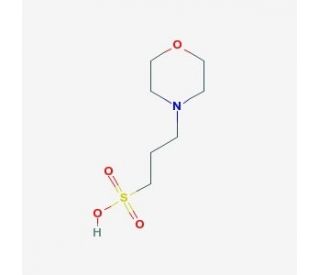

MOPS solution (CAS 1132-61-2)
QUICK LINKS
MOPS solution, a zwitterionic biological buffer, is extensively used in biochemical and molecular biology research for its exceptional buffering capacity in the pH range of 6.5 to 7.9. Its primary utility lies in maintaining pH stability during biochemical reactions, which is crucial for accurate and reproducible results. MOPS is particularly favored in RNA studies because it minimizes RNA degradation, unlike buffers that contain amine groups, which can cleave RNA chains. This makes it an ideal choice for RNA isolation, gel electrophoresis of RNA, and other molecular biology protocols focusing on RNA integrity. In protein research, MOPS is used in protein electrophoresis, including SDS-PAGE, where it serves as a running buffer, ensuring that the pH environment supports protein stability and consistent migration patterns. The buffer is also commonly used in the culturing of mammalian cells and other sensitive biological samples that require a strictly controlled pH environment. Its low ionic strength and minimal interference with biological processes make it suitable for various enzymatic assays, including those that monitor enzyme kinetics and activities within cellular pathways. The versatility of MOPS solution in these research settings underscores its importance in providing a stable and conducive environment for the study of complex biological systems.
MOPS solution (CAS 1132-61-2) References
- Involvement of NO and EDHF in flow-induced vasodilation in isolated hamster cremasteric arterioles. | Watanabe, S., et al. 2005. J Vasc Res. 42: 137-47. PMID: 15677873
- Involvement of hydrogen peroxide in the manganese-induced myocytes mitochondrial membrane potential loss. | Yang, H., et al. 2009. Toxicol Mech Methods. 19: 66-72. PMID: 19778235
- Pyoverdine secreted by Pseudomonas aeruginosa as a biological recognition element for the fluorescent detection of furazolidone. | Yin, K., et al. 2014. Biosens Bioelectron. 51: 90-6. PMID: 23942357
- Calcium dependence of voltage sensitivity in adenosine 3',5'-cyclic phosphate-stimulated sodium current in Pleurobranchaea. | Gillette, R. and Green, DJ. 1987. J Physiol. 393: 233-45. PMID: 2451737
- Airborne fine particulate matter induces an upregulation of endothelin receptors on rat bronchi. | Wang, R., et al. 2016. Environ Pollut. 209: 11-20. PMID: 26618262
- Tension development in frog skeletal muscle induced by silver ions. | Oba, T. and Hotta, K. 1985. Jpn J Physiol. 35: 841-51. PMID: 3001394
- Separation of Stabilized MOPS Gold Nanostars by Density Gradient Centrifugation. | Chandra, K., et al. 2017. ACS Omega. 2: 4878-4884. PMID: 31457766
- Hydrogen ion buffers for biological research. | Good, NE., et al. 1966. Biochemistry. 5: 467-77. PMID: 5942950
- A new discontinuous buffer system for the electrophoresis of cationic proteins at near-neutral pH. | Thomas, JM. and Hodes, ME. 1981. Anal Biochem. 118: 194-6. PMID: 6278979
- Buffers of constant ionic strength for studying pH-dependent processes. | Ellis, KJ. and Morrison, JF. 1982. Methods Enzymol. 87: 405-26. PMID: 7176924
Ordering Information
| Product Name | Catalog # | UNIT | Price | Qty | FAVORITES | |
MOPS solution, 100 ml | sc-301170 | 100 ml | $31.00 | |||
MOPS solution, 500 ml | sc-301170A | 500 ml | $60.00 |